Indigo Bunting Migration 2026: Schedule, Map & How to Attract
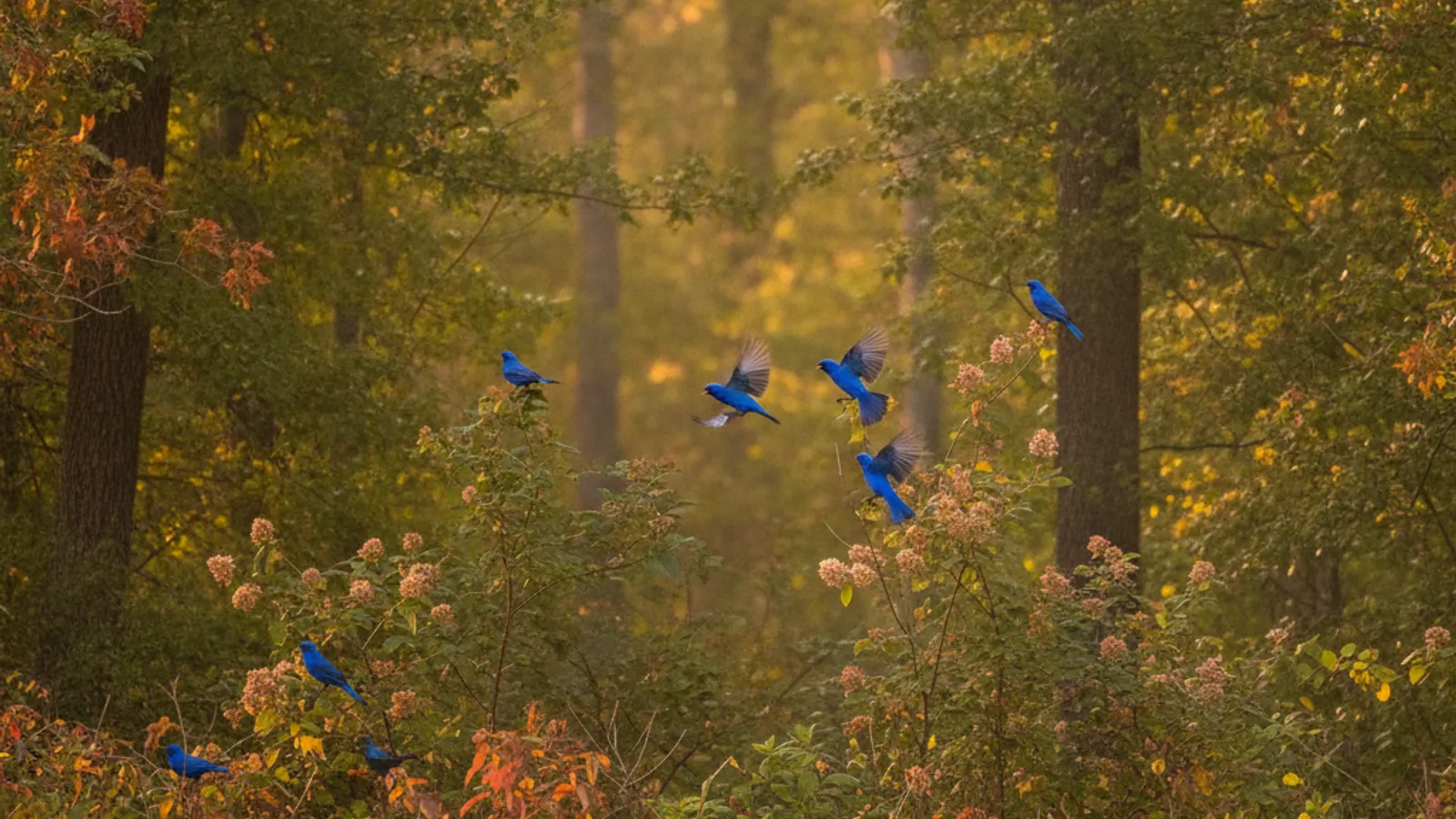
A male Indigo Bunting in full breeding plumage is one of the most striking birds in North America, pure electric blue, glowing in sunlight. They are also one of the most overlooked spring arrivals because they tend to sing from the very tops of trees. Knowing when they show up and what habitat they prefer is the difference between hearing them sing and actually seeing the blue.
Where Do Indigo Buntings Spend the Winter?
Indigo Buntings winter from southern Mexico through Central America and into northern South America (Colombia, Venezuela). They share their wintering range with Painted Buntings and several warbler species, often in scrubby second-growth and forest edges.
Indigo Bunting Migration Route & Timing
Indigo Buntings are nocturnal migrants that navigate using the stars, they orient by the rotation of the night sky around Polaris. They cross the Gulf of Mexico in non-stop overnight flights and then advance northward at roughly 30–50 miles per day in spring.
- Late March: First arrivals reach the Texas and Louisiana Gulf Coast.
- April: Birds spread across the southeastern US, reaching Georgia, the Carolinas, and Tennessee mid-month.
- Late April–early May: Northeastern arrivals (PA, NJ, NY, southern New England).
- Mid-May: Northern breeding range filled (MN, WI, MI, ME, southern Canada).
- Fall departure (Aug–Oct): Reverse the route, with peak movement in September. Most birds are out of the US by mid-October.
Indigo Bunting Migration Schedule 2026: Arrival Dates by Region
| Region | First Arrivals | Peak | Fall Departure |
|---|---|---|---|
| Gulf Coast (TX, LA, MS, AL, FL) | March 25 – April 5 | Mid-April | September |
| Deep South (GA, SC, NC) | April 5 – 15 | Late April | September |
| Mid-South (TN, KY, VA, AR) | April 12 – 22 | Early May | Mid-September |
| Mid-Atlantic (PA, MD, DE, NJ) | April 22 – May 2 | Mid-May | Mid-September |
| Great Lakes (OH, IN, IL, MI) | April 28 – May 8 | Mid-May | Early September |
| New England (NY, MA, CT, VT, NH) | May 5 – 15 | Late May | Late August |
| Upper Midwest (MN, WI, IA, NE) | May 8 – 18 | Late May | Late August |
| Southern Canada (ON, QC) | May 12 – 22 | Late May / early June | Late July |
How to Attract Indigo Buntings to Your Yard
Indigo Buntings are seed eaters that respond well to feeders, but only if your yard offers their preferred habitat: brushy edges and second-growth.
- Nyjer (thistle) seed. The single most reliable food. Use a tube feeder or thistle sock. Indigo Buntings join goldfinches and pine siskins at thistle feeders.
- White proso millet. Their second favorite. Sprinkle on platform feeders or directly on the ground. Cheap and effective.
- Mealworms in spring. During the first week or two after arrival, when females are building toward egg-laying, live mealworms attract them strongly.
- Brushy edges. Indigo Buntings nest in dense, shrubby growth at the edge of woods, fields, or roadsides. If your yard backs up to woods, leave a strip of unmowed brush, that habitat alone can attract a breeding pair.
- Birdbath with moving water. A small dripper or fountain attracts buntings. They bathe enthusiastically and drink several times a day.
- Avoid open lawn. Manicured turfgrass yards rarely host Indigo Buntings. They want cover within 20 feet of food sources.
How to Identify Indigo Buntings
- Adult male: brilliant electric blue all over, slightly darker on the head. The blue is structural, refraction off feather barbs, not pigment.
- Female: warm tan-brown overall, with faint streaking on breast and white throat. Easily mistaken for a sparrow.
- Both sexes show a stout conical seed-eater bill.
- First-spring males: patchy, mottled blue and brown, they look like they're molting (because they are).
- Compare with Blue Grosbeak (larger, two rusty wing bars) and Eastern Bluebird (rusty breast, very different shape).
Frequently Asked Questions
When do Indigo Buntings come back?
Indigo Buntings return to the southern US (Texas, Louisiana, Florida) in late March, the southeastern states by mid-April, the Mid-Atlantic by late April, and the upper Midwest and New England by mid-May.
Are Indigo Buntings really blue?
Indigo Bunting blue is structural color, created by light refraction off the microstructure of feather barbs, not pigment. In dull light or shadow, the bird looks black. In direct sunlight, the blue is electric. This is the same effect that makes a Blue Jay blue.
How do you attract Indigo Buntings?
Offer Nyjer thistle seed and white proso millet, provide a birdbath with moving water, leave brushy edges in your yard, and don't mow every inch of your property. They prefer yards bordered by woods or unmowed fields.
Where do Indigo Buntings nest?
They build cup nests of grass and bark strips in dense shrubs or briars 1–6 feet off the ground. Common locations include blackberry thickets, brush piles, and shrubby field edges. Females typically raise two broods per season.
What does an Indigo Bunting song sound like?
A bright, paired-phrase song from a high perch: "fire-fire, where-where, here-here, see-it, see-it." Each male's song is slightly different but follows the paired-phrase structure. Use Merlin Sound ID to confirm, the algorithm picks them up reliably.
Related Reading
- Spring Bird Migration 2026: Complete Guide
- Baltimore Oriole Migration 2026
- Purple Martin Migration 2026
- Ruby-Throated Hummingbird Migration 2026
- How to Attract Birds to Your Yard
Indigo Bunting Backyard Setup
As an Amazon Associate we earn from qualifying purchases. Links below help support BirdSpot at no cost to you.
Indigo buntings are seed-eaters, they’ll come to feeders with white millet, nyjer, and small sunflower:
- Nyjer/thistle feeder, Buntings hit the same feeders as goldfinches.
- White proso millet (10 lb), Buntings prefer millet over sunflower, this is the key.
- Platform feeder (ground feeders), Some buntings prefer feeding low to the ground.
- Vortex Diamondback HD 8x42, Sharp enough to see the iridescent blue clearly.
For more, see Best Bird Feeders 2026.