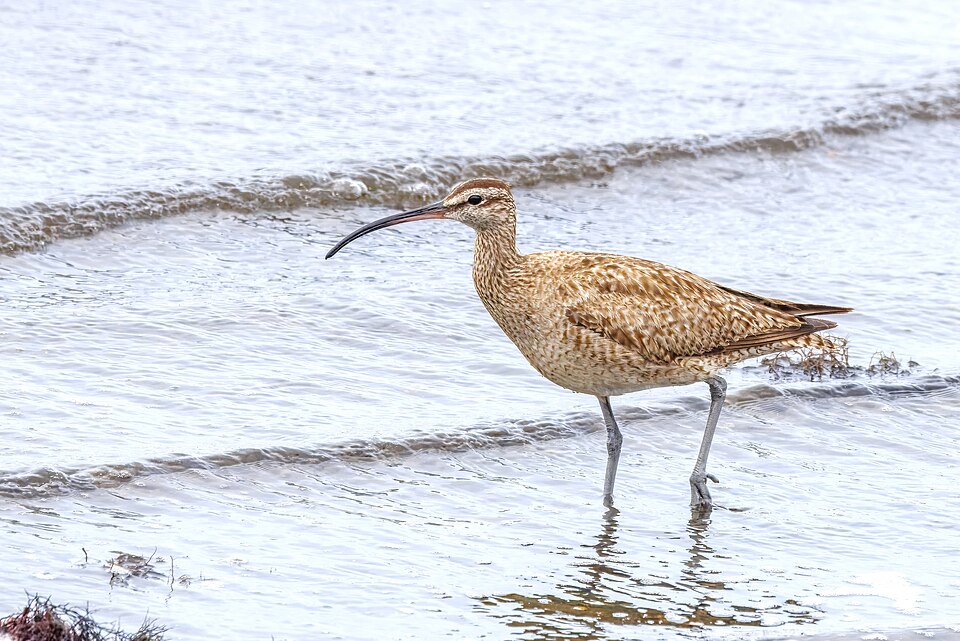
The Whimbrel is a big, sturdy brown shorebird best known for two things: its long, smoothly downcurved bill and its bold, striped head pattern. It is a member of the curlew family, and at a distance it looks like a curlew shrunk down a size or two. Where you find it, you usually find it on the move. Whimbrels are among the great long-distance travelers of the bird world, breeding on the arctic and subarctic tundra and wintering on coastlines as far south as South America, Africa, and Australia. A single bird may cross thousands of miles of open ocean in one nonstop flight.
For most North American and European birders, the Whimbrel is a bird of migration and winter rather than a backyard visitor. You meet it on a mudflat, a tidal estuary, a rocky shoreline, or a coastal pasture, usually striding deliberately and probing the mud for crabs. Its far-carrying, rippling whistle is one of the classic sounds of the spring and fall shorebird migration, and learning that call is often the fastest way to pick this species out of a crowded flat.
Start with the overall impression: a large, long-legged, gray-brown shorebird, clearly bigger and bulkier than the average sandpiper, with a long bill that curves smoothly downward. The single most useful field mark is the head pattern. Unlike most brown shorebirds, the Whimbrel wears a crisp dark cap split by a pale central stripe, with a dark line through the eye. Get that striped crown plus the decurved bill and you have your bird.
| Bill | Long and smoothly decurved (downcurved), roughly twice the length of the head; dark with a paler base to the lower mandible |
| Head pattern | Bold dark crown stripes split by a pale central crown stripe, plus a dark eye line and pale supercilium - the key field mark |
| Overall color | Cool grayish-brown above with fine streaking and barring; paler, finely streaked underparts grading to whitish belly |
| Size and build | Large and stocky for a shorebird, with long bluish-gray legs and a deliberate, upright walk |
| In flight | Brown above with a wedge of whitish on the lower back and rump in many populations; steady, deep wingbeats |
| Voice clue | A rapid, even, rippling whistle of about 5-7 notes - often heard before the bird is seen |
Male vs. female
Males and females look essentially identical in the field, sharing the same striped crown, decurved bill, and brown plumage. Females average slightly larger and tend to have a marginally longer bill, but this difference is subtle and only reliable when birds can be directly compared side by side. There is no seasonal or breeding-versus-nonbreeding plumage difference dramatic enough to separate the sexes, so for practical birding purposes you should treat the sexes as alike.
Juveniles
Juvenile Whimbrels look much like adults but are freshly and neatly plumaged, with crisp pale spotting and notching along the edges of the upperpart feathers that gives them a slightly more spangled, tidy appearance than worn adults. Their bills are often noticeably shorter than an adult's during their first months, since the bill continues growing after fledging. Young birds seen on southbound migration in late summer and fall are frequently the most evenly patterned and clean-looking Whimbrels you will encounter.
The Whimbrel's signature call is a fast, even series of short whistled notes, usually about five to seven of them, all on roughly the same pitch and delivered in a rapid rippling or tittering run, often written as a rolling pi-pi-pi-pi-pi-pi-pi or ti-ti-ti-ti-ti. This bubbling whistle is distinctive and carries a long way over open flats and water; many birders detect Whimbrels overhead by ear before spotting them. The cadence is more clipped and mechanical than the mournful, rising call of the larger curlews.
On the breeding grounds the male performs a flight display accompanied by a longer, more musical song - a series of bubbling trills and rising whistles that swell into a rich, far-carrying refrain across the tundra. Away from the nesting territory, though, the rapid seven-note whistle is the sound you will come to associate with the species.
The Whimbrel has one of the broadest distributions of any shorebird, breeding across the high latitudes of North America, Europe, and Asia, and wintering along coastlines of six continents. North American breeders nest on tundra in Alaska and across arctic and subarctic Canada around Hudson Bay. European and Asian populations nest from Iceland and northern Britain across Scandinavia and Siberia.
It is a champion long-distance migrant. North American birds funnel down to the coasts of the southern United States, the Caribbean, Central America, and especially South America, and many make spectacular nonstop transoceanic flights over the Atlantic. In spring and fall, look for Whimbrels staging on coastal mudflats, salt marshes, beaches, and estuaries, where they pause to refuel. Outside the breeding season they are overwhelmingly coastal, and most inland sightings are brief stopovers by migrating birds.
On the wintering grounds and at coastal stopovers, the Whimbrel is famous as a crab specialist. It strides across mudflats and rocky shores hunting fiddler crabs and other small crustaceans, using its long curved bill to probe deep into burrows and extract the prey. A foraging Whimbrel will often pause, watch, then make a deliberate jab - and it frequently removes the legs and claws of a crab before swallowing the body. Mollusks, marine worms, and other invertebrates round out the coastal diet.
On the breeding tundra the menu shifts toward insects and their larvae, spiders, and other small invertebrates picked from the ground and vegetation, and Whimbrels there also eat berries, especially crowberries and other tundra fruit, fattening up before the long southward flight. This flexibility - probing for crabs on the coast, gleaning insects and berries on the tundra - helps the species occupy such a vast geographic range.
Whimbrels nest on open ground in arctic and subarctic tundra, moorland, and similar treeless habitats, often near water. The nest is a simple shallow scrape on the ground, lined with a little moss, lichen, grass, or leaves, and typically placed in low vegetation that offers some concealment. Pairs are territorial on the breeding grounds and will mob and dive-bomb intruders, including humans and predators that wander too close.
The female usually lays four eggs, olive to brownish and marked with darker blotches that blend into the tundra. Both parents share incubation over roughly three and a half to four weeks. The young are precocial - down-covered and able to leave the nest and feed themselves soon after hatching - though the parents continue to guard and brood them. Whimbrels raise a single brood per season, timed to the brief but insect-rich arctic summer.
The Whimbrel is not a backyard or feeder bird, so there is no seed mix or nest box that will bring one to your garden. It is a wild coastal and tundra-nesting shorebird that you go to, rather than one that comes to you. That said, there is plenty you can do to find and enjoy them well.
- Go coastal during migration. Your best odds are on tidal mudflats, estuaries, salt marshes, and beaches in spring (roughly April-May) and late summer through fall (July-October).
- Time your visit to the tide. A falling or low tide exposes the flats where Whimbrels probe for crabs; a rising tide can push feeding birds closer to shore and concentrate them at roosts.
- Learn the call first. The rapid rippling seven-note whistle often reveals Whimbrels flying overhead before you ever see them - listen for it.
- Scan with a scope. Whimbrels often forage at a distance on open flats; a spotting scope lets you confirm the striped crown and decurved bill without flushing them.
- Check coastal pastures and golf courses near the shore. Migrants sometimes feed on short grass and damp fields inland of the immediate coast.
- Watch from a distance and avoid flushing. Migrating shorebirds need to feed and rest; keeping your distance helps them refuel for their long journeys.
- Long-billed Curlew: Much larger with an extremely long, dramatically downcurved bill and a plain buffy face lacking the Whimbrel's bold striped crown; shows cinnamon tones, especially in the wings.
- Marbled Godwit: Similar size and warm brown coloring, but its long bill is straight or slightly upturned (not downcurved) and pinkish at the base, and it lacks the striped head.
- Eurasian Curlew: Larger and longer-billed than a Whimbrel, with a plainer, evenly streaked head lacking strong crown stripes; gives a mournful, rising cur-lee call rather than a rippling whistle.
- Bristle-thighed Curlew: A close Whimbrel look-alike of the Pacific; best separated by its bright buffy-cinnamon rump and tail and a distinctive loud whistled call, plus very limited range.
How do I tell a Whimbrel from a curlew?
Size and head pattern are the keys. Whimbrels are smaller than the big curlews and have a bold striped crown - a dark cap split by a pale central stripe, with a dark eye line. The large curlews (like Long-billed and Eurasian) have longer bills and plainer, more evenly streaked heads without those crisp crown stripes. Voice also helps: the Whimbrel gives a rapid rippling whistle, while curlews give longer, more mournful rising calls.
What does a Whimbrel eat?
On the coast, Whimbrels are crab specialists, using their long curved bills to pull fiddler crabs and other crustaceans from burrows in the mud; they also take marine worms and mollusks. On the breeding tundra they switch to insects, larvae, spiders, and berries such as crowberries, which they eat to build up fat before migration.
Why is the Whimbrel's bill curved downward?
The decurved bill is a feeding adaptation. It lets the bird probe deep into the curving burrows of crabs and into soft mud and sand to reach buried invertebrates that a straight bill could not follow. The curve effectively gives the Whimbrel access to prey hidden below the surface.
Where and when can I see a Whimbrel?
Look on coastal mudflats, estuaries, salt marshes, and beaches during migration - generally spring (April-May) and late summer into fall (July-October). They breed far north on arctic and subarctic tundra and winter on coastlines as far south as South America, Africa, and Australia. Inland sightings are usually brief migration stopovers.
Is the Whimbrel endangered?
The Whimbrel is currently listed as Least Concern globally because of its huge range and large total population. However, some regional populations have declined noticeably, and the species faces pressures from habitat loss at key coastal staging sites. It remains common in many areas but is worth keeping an eye on.