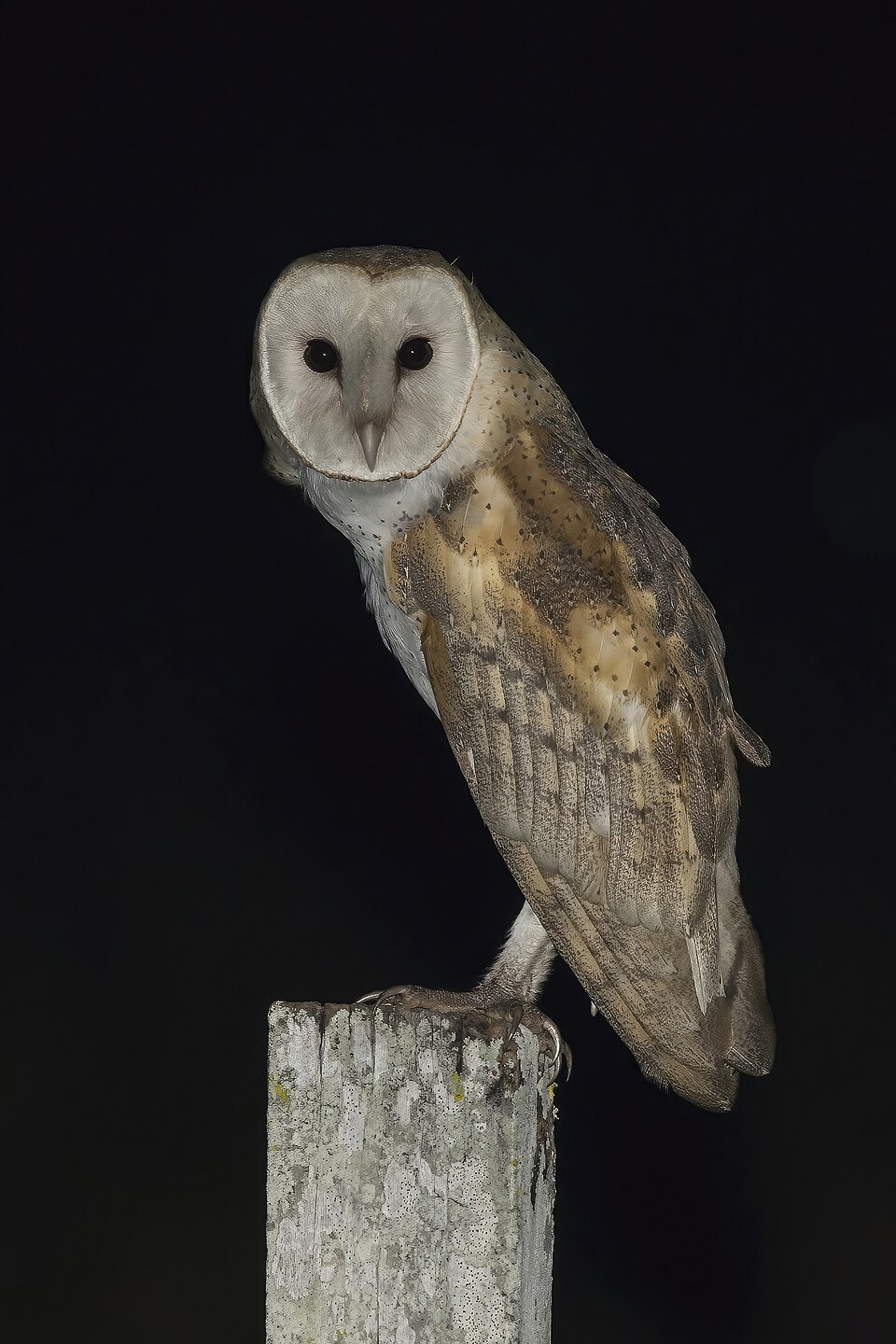
Few birds look as otherworldly as the Barn Owl. Glide past a dark barn or a moonlit hayfield and you may catch a long-winged, ghost-pale shape floating low over the grass on silent wings, its white underparts almost glowing. This is one of the most widespread land birds on Earth, found on every continent except Antarctica, yet many people never see one because it hunts by night and roosts by day in quiet, hidden places.
The Barn Owl earns its name honestly. Long before it adapted to barns, silos, church towers, and nest boxes, it nested in tree hollows and rock cavities, but human structures gave it exactly what it loves: dark, sheltered ledges near open hunting ground. It is a tireless mouser, and a single family can take a remarkable number of rodents in a season, which is why farmers have welcomed it for centuries. Unlike most owls, it has no ear tufts and gives no classic hoot. Instead it screeches, hisses, and snores in the dark, sounds that fueled countless ghost stories.
The Barn Owl is a medium-sized, long-legged owl with a distinctive heart-shaped white face, a slim body, and rounded wings that look long and broad in flight. Perched, it sits upright and looks pale and front-heavy; in flight it appears almost entirely white from below and buoyant, often hovering or quartering low over open ground.
| Face | Clean, white, heart-shaped facial disk rimmed with a fine tan edge; dark, forward-facing eyes |
| Upperparts | Soft golden-buff and gray, finely speckled with white and black flecks |
| Underparts | White to pale buff, often with a scatter of small dark spots; looks ghostly white in flight |
| Head | Smoothly rounded with NO ear tufts, unlike Great Horned or screech-owls |
| Legs | Long, feathered legs that often dangle in flight; helps separate it from other owls |
| Flight | Silent, moth-like, low quartering over fields with deep, slow wingbeats and frequent hovering |
Male vs. female
Males and females look broadly alike and can be tricky to separate in the field, but there are useful tendencies. Females average larger and tend to be more richly colored, with a buffier, more golden chest and noticeably more dark spotting on the underparts and face edge. Males are often paler, sometimes nearly pure white below with few or no spots. Researchers have found that heavily spotted females tend to be in better condition, but on a quick nighttime look you usually cannot reliably sex a bird, so treat any difference as a soft clue rather than a rule.
Juveniles
Young Barn Owls in the nest are covered in white then buffy down for weeks before their flight feathers grow in. Once fledged, juveniles look much like adults and are hard to age in the field, since they acquire adult-like plumage quickly. A telltale sign of a recently fledged bird is behavior rather than plumage: branchlings clamber awkwardly around the nest site, beg loudly with raspy hisses and snores, and make short, clumsy first flights before mastering the smooth, silent quartering of an adult.
The Barn Owl does not hoot. Its signature sound is a long, harsh, rasping scream, a drawn-out shrreeee often given in flight, eerie enough to be mistaken for a person or a startled animal in the dark. It is one of the most distinctive night sounds in farm country.
Away from that scream, Barn Owls make a wide range of hisses, raspy snores, and bill-snapping when alarmed or defending a roost. Nestlings produce an insistent, snoring kssssh that is begging for food and can carry surprisingly far from a barn or box on a still night. If you hear what sounds like a hissing snake coming from a rafter or nest box, it may well be a young Barn Owl.
The Barn Owl is one of the most cosmopolitan birds in the world, occurring across the Americas, Europe, Africa, southern Asia, and Australia. In North America it is largely a resident of the southern and central United States, the West Coast, and Mexico, thinning out northward; it is scarce or absent across the colder northern tier and most of Canada.
It is largely non-migratory, holding territory year-round where winters are mild. Northern and high-elevation birds, however, may wander or shift southward in hard winters when deep snow makes rodents impossible to catch. Numbers can swing with prey: in years when voles and mice boom, Barn Owls nest more and survive better; in lean years, populations in the cold fringes of the range can crash.
Barn Owls are specialized rodent hunters, and few birds are better at it. Their diet is dominated by small mammals, especially voles, mice, shrews, rats, and pocket gophers, with the exact mix depending on what is abundant locally. They occasionally take small birds, bats, or large insects, but rodents are the heart of the menu.
They hunt almost entirely by sound. Their lopsided ear openings and that dish-like facial disk funnel the faintest rustle of a mouse in grass, letting them pinpoint and strike prey in total darkness. Combined with fringed flight feathers that muffle nearly all wing noise, this makes them deadly silent ambush hunters. A typical hunt is a slow, low quartering flight over open fields, sudden hover, and a feet-first plunge into the grass. Indigestible fur and bone are coughed up as pellets, which pile up beneath roosts and are a classic way to confirm a Barn Owl is using a site.
Barn Owls are cavity nesters that build essentially no nest. The female lays her eggs directly on whatever floor the site offers, often a bed of old, crumbled pellets. Favored sites include barn lofts, silos, church towers, hollow trees, cliff cavities, and, very reliably, large nest boxes put up specifically for them.
The female does all the incubating, beginning with the first egg, while the male hunts and delivers food. Because incubation starts early, the chicks hatch days apart and end up as a staircase of sizes in the nest. In good prey years they can raise large families and may even attempt a second brood. This high reproductive potential is what lets Barn Owl numbers rebound quickly after a hard winter or a prey crash.
The Barn Owl is not a feeder bird, but it is one of the most rewarding owls to attract because it readily takes to nest boxes. If you have open grassy land nearby, a field, pasture, orchard, vineyard, or marsh edge with a healthy rodent population, you have a real chance of hosting one.
- Put up a proper Barn Owl box. These owls need a large, deep box (roughly the size of a small crate, not a songbird box) mounted 10-15 ft up on a pole, tree, or building wall facing open hunting ground.
- Keep open hunting habitat nearby. Barn Owls need grassland or field edges full of voles and mice within easy flight; a box in dense forest or pure suburbia rarely succeeds.
- Never use rodenticides. Poisoned rodents kill the very owls you want, and a Barn Owl family is far more effective rodent control than any bait station.
- Provide a quiet, dark roost. Leaving an old barn, outbuilding, or silo accessible with a high, sheltered ledge can draw birds even without a box.
- Be patient and hands-off. It may take a season or two for owls to find a new box; once they do, avoid disturbing the site during nesting.
- Short-eared Owl: Also hunts low over open fields, but is brown and streaky overall with a buffy face and dark eye patches, not pale white with a heart face.
- Snowy Owl: Much larger and bulkier, rounded head, yellow eyes, and active by day in winter; Barn Owl is smaller, slimmer, with dark eyes and a heart-shaped face.
- Barred Owl: A woodland owl with a round gray-brown head, dark eyes, and vertical belly streaking; gives a hooting 'who-cooks-for-you' rather than a screech.
- Western Screech-Owl: Tiny by comparison, with prominent ear tufts and yellow eyes; Barn Owl is far larger, tuftless, with dark eyes.
What sound does a Barn Owl make?
Not a hoot. Its trademark call is a long, harsh, raspy scream, often given in flight, along with hisses, snores, and bill-snapping. Begging nestlings make a snake-like hissing snore that can carry far from a barn or box.
Are Barn Owls dangerous to pets or chickens?
No. Barn Owls specialize in small rodents like voles and mice and are far too small to threaten cats, dogs, or adult chickens. They are excellent natural pest control and are welcomed by most farmers.
Where do Barn Owls live and sleep during the day?
They roost by day in dark, sheltered places: barn lofts, silos, hollow trees, cliff cavities, church towers, and nest boxes. They emerge at dusk to hunt over open fields and return to the same roost regularly.
How can I attract a Barn Owl to my property?
Put up a large Barn Owl nest box mounted high and facing open grassy land with plenty of mice and voles, and never use rodent poison. With suitable habitat nearby, owls will often find and use the box within a season or two.
Why is a Barn Owl's face shaped like a heart?
The heart-shaped facial disk acts like a satellite dish, funneling sound toward the owl's ears. Combined with lopsided ear openings, it lets the owl locate prey by sound alone and catch mice in complete darkness.