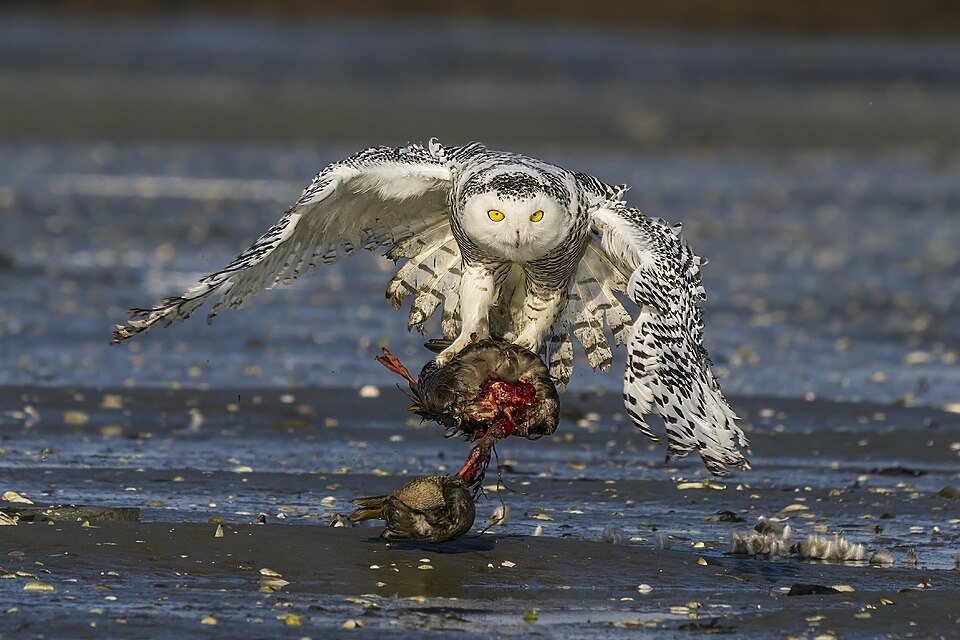
Few birds stop people in their tracks like a Snowy Owl. Big, round-headed, and startlingly white, it belongs to the open Arctic tundra where it hunts in the endless daylight of the polar summer. Unlike most owls, it is built for a treeless world, so it perches low on the ground, on fence posts, hay bales, or rooftops, sitting bolt upright like a snowman that turns its head to watch you. It is one of the heaviest owls in North America, and a large female can weigh more than a Great Horned Owl.
For most birders in the lower United States and southern Canada, the Snowy Owl is a thrilling winter visitor rather than a year-round resident. In some winters they push far south of their breeding range in dramatic movements called irruptions, turning up on beaches, airports, farm fields, and even city waterfronts. These events draw crowds of admirers, but they are also reminders of a species under pressure: the Snowy Owl is now classified as Vulnerable, with a population closely tied to the boom-and-bust cycles of Arctic lemmings.
A Snowy Owl is hard to mistake for anything else: a very large, bulky owl with a rounded head, no ear tufts, and bright yellow eyes set in a broad, flattish face. Its dense feathering extends right down over the legs and feet, giving it a shaggy, fully-clothed look built for brutal cold. Posture is a great clue: it usually sits low and upright on open ground rather than in trees.
| Overall color | White to white with dark barring and spotting; amount of dark varies by age and sex |
| Head | Large, smoothly rounded, with no ear tufts; small head movements as it scans |
| Eyes | Piercing golden-yellow, forward-facing in a broad facial disc |
| Bill | Black, mostly hidden by white facial bristles |
| Feet & legs | Heavily feathered to the toes, with black talons |
| Size & shape | Very large and heavy-bodied; broad rounded wings; perches upright on the ground |
Male vs. female
Sexes look broadly similar but differ in how much dark marking they carry, which is unusual and helpful. Adult males are the whitest, often nearly pure snow-white with only a few fine dark flecks, and the oldest males can be immaculate. Females are noticeably larger and more heavily marked, with bold dark bars and spots across the wings, back, crown, and flanks, though the face, throat, and feet stay white. As a rough rule, a strikingly clean white bird is likely an older male, while a heavily barred bird is a female. Beware that young males can be quite marked too, so age muddies the picture.
Juveniles
Juveniles and first-winter birds are the most heavily marked of all, densely barred with dark gray-brown so they can look quite dark at a distance, especially across the body and wings. The white face and pale underwings still show, and the yellow eyes are present from early on. Because young females are the darkest and old males the whitest, a single winter flock can show a whole spectrum from nearly black-and-white barred to almost pure white, which often confuses first-time observers trying to age and sex them.
Snowy Owls are mostly silent on the wintering grounds, which is one reason wintering birds are usually detected by sight rather than sound. On the breeding tundra they are far more vocal. The male's territorial and courtship call is a deep, far-carrying, gruff hoot, often given in a series of two to six notes, a hard krooh-krooh or hoo... hoo... that can carry for miles across open ground.
Both sexes also use a range of harsher calls when agitated or defending the nest, including a rasping, barking kre-kre-kre, cackles, and bill-snapping. Females may give a higher, mewing or whistling note. Near the nest, alarmed birds add hissing and loud bill-clapping as a warning.
Snowy Owls breed across the high Arctic tundra in a circumpolar band that includes northern Alaska, Arctic Canada, Greenland, and northern Eurasia. They nest where the ground is open and rolling, near reliable prey, and they may skip breeding entirely in years when lemmings are scarce. Because of this, breeding sites shift from year to year rather than staying fixed.
In winter, many birds move south into southern Canada and the northern United States, with numbers varying enormously. In big irruption years they appear well south of usual, sometimes reaching the central states and rarely farther. These movements are driven largely by food and breeding success, not simply by cold, so a strong lemming summer can produce a wave of young owls heading south the following winter. Open, treeless habitats that mimic tundra, such as shorelines, dunes, prairies, large farm fields, and airports, are the classic places to look.
On the breeding grounds the Snowy Owl is a lemming specialist, and its nesting success rises and falls with lemming abundance. In a good year an owl family can consume thousands of these small rodents over a season. The owl hunts by sitting on a low vantage point and watching, then dropping or flying out to seize prey with its powerful, fully feathered talons. Unlike most owls, it hunts readily in daylight, a necessity in the round-the-clock sun of the Arctic summer.
Away from the tundra and in winter, it is far more flexible, taking voles, mice, rabbits, hares, and a wide range of birds up to the size of ducks, grebes, and gulls. Coastal wintering birds often hunt waterfowl and seabirds, and some learn to patrol harbors and beaches. Snowy Owls will also scavenge and may cache surplus food when prey is plentiful.
Snowy Owls nest on the ground, which suits a bird of the treeless tundra. The female chooses a slightly raised, snow-free site such as a hummock, ridge, or knoll with a wide view, and scrapes a shallow depression in the ground rather than building a lined nest. These vantage points let the pair watch for approaching predators like foxes and jaegers.
Clutch size is closely tied to food: in lemming-rich years a female may lay a large clutch, while in poor years pairs may lay few eggs or not nest at all. The female incubates while the male hunts and delivers food. Eggs hatch over a span of days, so the brood is staggered in age, and both parents fiercely defend the nest, dive-bombing intruders and using distraction displays. Young leave the nest on foot before they can fly well and continue to be fed for weeks afterward.
This is not a backyard or feeder bird, and there is no realistic way to attract one to a typical yard. Snowy Owls are wild Arctic predators that need open, prey-rich habitat, so the goal is to find and respectfully observe them rather than lure them in.
- In winter, scan open treeless habitats that resemble tundra: lake and ocean shorelines, dunes, large farm fields, prairies, and airport edges.
- Look for a white lump perched low and upright on the ground, a fence post, hay bale, or rooftop, often sitting motionless for long periods.
- Check local birding alerts and eBird during the colder months; in irruption years sightings are widely reported and easy to follow up on.
- Keep your distance and use binoculars or a scope. Never flush an owl to get a closer photo; wintering birds are often stressed and need to conserve energy.
- Watch at dawn and dusk for active hunting, but remember these owls will also perch and hunt in broad daylight.
- If a bird is on an airport or roadway, report it to local authorities or a raptor rescue rather than approaching, for the bird's safety and yours.
- Great Horned Owl: Similar bulk but mottled brown, with prominent ear tufts and a tree-perching habit; never clean white.
- Barn Owl: Pale and ghostly in flight but much smaller and slimmer, with a heart-shaped white face and dark eyes, plus golden-buff upperparts.
- Short-eared Owl: Shares open-country habitat and daytime hunting, but is far smaller, tawny-brown, and flies with floppy, moth-like wingbeats.
- Gyrfalcon: A white-morph Gyrfalcon can fool a distant glimpse, but it is a streamlined, pointed-winged falcon, not a round-headed perched owl.
Are Snowy Owls really white like in Harry Potter?
Yes, but it depends on the bird. The whitest birds are old males, which can be nearly pure white. Females and young birds are heavily marked with dark bars and spots, so many real Snowy Owls look much darker than the famous fictional one.
Where can I see a Snowy Owl in the United States?
In winter, look in open treeless places that resemble tundra: ocean and lake shorelines, dunes, large farm fields, prairies, and airports across the northern states. In irruption years they appear farther south. Birding alerts and eBird are the best way to find current sightings.
What is a Snowy Owl irruption?
An irruption is a winter when unusually large numbers of Snowy Owls move south, far beyond their normal range. These events are driven mainly by Arctic breeding success and food supply rather than cold weather, so a strong lemming summer can send many young owls south the next winter.
What do Snowy Owls eat?
On the tundra they specialize in lemmings, small Arctic rodents. In winter and elsewhere they are flexible, taking voles, mice, rabbits, hares, and birds up to the size of ducks and gulls. Coastal wintering birds often hunt waterfowl and seabirds.
Do Snowy Owls hunt during the day?
Yes. Unlike most owls, Snowy Owls regularly hunt in daylight. This is an adaptation to the Arctic summer, when the sun never fully sets, but wintering birds also hunt by day, often most actively around dawn and dusk.