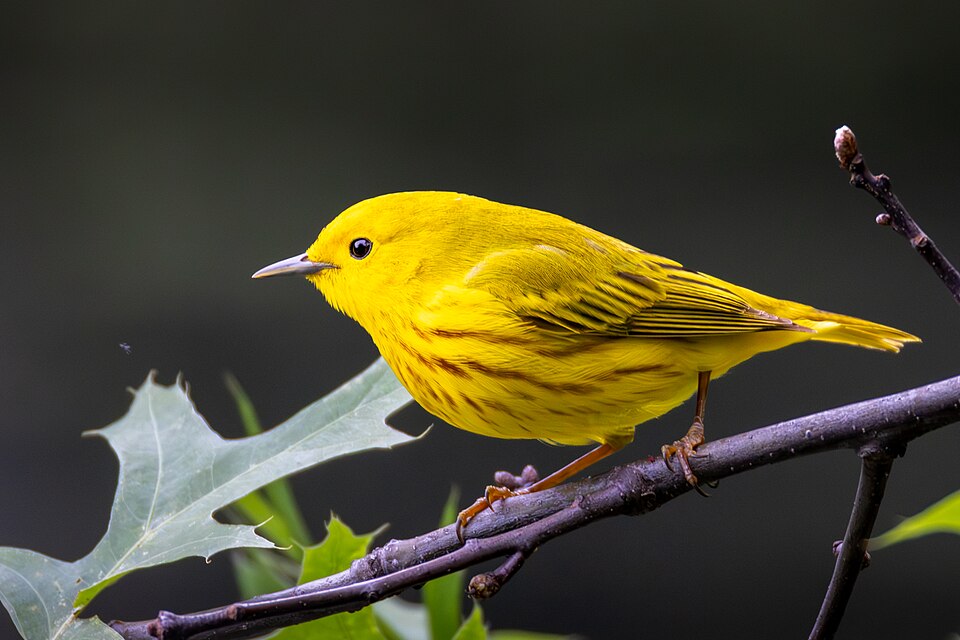
The Yellow Warbler is about as close as a small songbird gets to pure sunshine. Glowing egg-yolk yellow from head to tail, it flits through streamside willows, wet thickets, and shrubby field edges across nearly all of North America. Unlike many warblers that demand a careful squint through binoculars to identify, this one practically announces itself: a buttery little bird singing a cheerful, whistled phrase from an exposed twig. It is one of the most widespread and familiar warblers on the continent, and for many backyard birders it is the first warbler they ever name with confidence.
Beyond its good looks, the Yellow Warbler is a bird with grit. Males defend breeding territories with persistent song, females build remarkably tidy cup nests, and the species has evolved a clever defense against Brown-headed Cowbirds that try to dump eggs in its nest. It breeds farther north than almost any other warbler and winters as far south as the Amazon, packing an epic migration into a body that weighs less than a handful of paperclips.
This is a small, compact, round-headed warbler with a short tail and a relatively stout, straight bill for a wood-warbler. The overall impression is of an almost uniformly yellow bird with a plain face and large, gentle dark eye that stands out against the bright plumage. There are no wingbars to speak of, which helps separate it from many lookalikes.
| Overall color | Bright, even yellow over nearly the whole body, brightest on the head and underparts |
| Breast streaks | Males show thin rusty-red streaks down the breast and flanks (the field mark to confirm) |
| Face | Plain yellow face with a large, beady black eye and no mask, eyeline, or strong markings |
| Wings | Yellow edgings on the dark wing feathers; lacks bold white wingbars |
| Tail | Short tail with yellow spots in the tail (not white), visible from below in flight |
| Bill | Fairly stout and straight, dark, typical of an insect-gleaning warbler |
Male vs. female
Males are the brighter, more saturated lemon-yellow birds and show the diagnostic fine chestnut-red streaks running down the breast and sides, sometimes called the bird's "red necktie" pattern. Females are also yellow but noticeably plainer and a touch greener or duller, especially across the back, and they show faint streaking or none at all on the underparts. A female with no breast streaks and an unmarked yellow face can be tricky, so look at the tail spots (yellow, not white) and the lack of wingbars to confirm.
Juveniles
Juveniles and first-fall immatures are the dullest plumages and the ones that confuse people most. They range from washed-out grayish-yellow to a soft buffy or even grayish-green, particularly young females, and they lack the bright tone and breast streaks of adult males. The reliable clues stay the same: an overall pale, plain bird with a beady dark eye, a soft yellowish wash (no real contrast on the face), and crucially the yellow spots in the tail rather than the white tail spots most other warblers show.
The song is a bright, sweet, whistled series, and the classic mnemonic birders learn is "sweet-sweet-sweet, I'm-so-sweet" or "sweet-sweet-shredded-wheat." It is rapid, musical, and rises and tumbles at the end, typically delivered from an open perch on a shrub or low tree. Males sing persistently through the breeding season, and the phrase is one of the most useful early-summer sounds to learn because it carries well across open wet habitats.
The common call note is a sharp, sweet, downslurred "chip" or "tsip," cleaner and more musical than the harder chips of many sparrows. In flight and during migration listen for a high, thin, buzzy "zzee." Once the song clicks for you, you will start hearing Yellow Warblers in willow patches you never knew held them.
Yellow Warblers breed across an enormous swath of North America, from Alaska and northern Canada south through most of the United States, reaching into the mountains of Mexico. They favor moist, shrubby habitats almost everywhere they occur: willow and alder thickets along streams, wet meadows, marsh edges, second-growth, orchards, and overgrown field borders. This love of wet, brushy edges is one of the best clues to finding them.
They are long-distance migrants and one of the earlier-departing warblers in late summer. Most birds funnel south through Mexico and Central America to winter from the tropics of Mexico down through Central America and into northern South America. Spring migration brings them back north from April into May, with the far-northern breeders arriving latest. A distinctive group of "Mangrove" Yellow Warblers, with chestnut-hooded males, is resident in coastal mangroves of the tropics.
Yellow Warblers are primarily insectivores, and they earn their living gleaning small prey from leaves, twigs, and bark in the outer parts of shrubs and trees. Caterpillars are a staple, along with beetles, midges, mosquitoes, leafhoppers, aphids, and other small arthropods, plus spiders. They are active, restless foragers, hopping along branches and making short fluttering sallies to snatch insects, often working the leafy edges of willows and other waterside growth.
Because they target soft-bodied insects and caterpillars, they are genuinely beneficial birds to have around gardens and farms. They will occasionally take small fruits or berries, especially outside the breeding season, but the overwhelming majority of the diet is insect prey caught by hand-and-eye gleaning rather than anything they could get at a seed feeder.
The female builds a neat, deep, tightly woven open cup, usually placed in the upright fork of a shrub or small tree a few feet off the ground in dense, often wet vegetation. She constructs it from plant fibers, grasses, bark strips, and plant down, lining it with soft material such as hair and feathers. The result is one of the sturdiest little nests in the warbler world.
Yellow Warblers are heavily targeted by Brown-headed Cowbirds, which lay their eggs in the nest. Rather than abandon the site, a Yellow Warbler will often build a brand-new nest floor right over the cowbird egg (and any of her own eggs underneath), sometimes producing famous multi-story nests when cowbirds keep returning. A typical clutch is 4-5 eggs, pale with darker speckling, and the female does the incubating while the male helps feed the young.
Yellow Warblers are not feeder birds, so you won't lure them with seed, suet, or nectar. They are insect specialists, which means the way to attract them is to build the kind of moist, brushy habitat and insect supply they need. Yards near streams, ponds, or wet edges have by far the best odds.
- Plant native willows, alders, dogwoods, and dense shrubs, especially in damp or low-lying corners of the yard
- Provide or protect a water feature, a stream, pond, rain garden, or even a moving-water bird bath increases your chances
- Go pesticide-free so caterpillars and other soft insects (their main food) thrive
- Leave brushy, tangled edges and thickets rather than mowing or clearing everything to lawn
- Add native plants that host caterpillars, since caterpillars are a breeding-season staple
- Watch and listen during spring migration (April-May), when even non-breeding yards may host a passing bird
- Wilson's Warbler: Also bright yellow but the male wears a neat black cap; lacks the rusty breast streaks and shows a plainer, beadier look.
- American Goldfinch: Yellow but has a conical seed-eating bill, black wings with white wingbars, and (in males) a black forehead, a finch, not a warbler.
- Orange-crowned Warbler: Duller and greenish-yellow with faint blurry streaks and a thin eyeline; never as clean, bright, or evenly yellow as a Yellow Warbler.
- Common Yellowthroat: Yellow throat but a brownish back and (in males) a bold black bandit mask; skulks low in marsh vegetation rather than singing in the open.
What bird is bright yellow all over?
In most of North America, an all-yellow small songbird in shrubby, wet habitat is most likely a male Yellow Warbler. Look for fine rusty-red streaks down the breast to confirm it. If the bird has black wings with white wingbars and a stubby seed-eating bill, it's an American Goldfinch instead.
How do I tell a Yellow Warbler from an American Goldfinch?
The bill is the giveaway. Yellow Warblers have a thin, pointed insect-eating bill, plain yellow wings without bold wingbars, and (males) reddish breast streaks. Goldfinches have a short conical bill, black wings with white wingbars, and males show a black forehead patch. They also behave differently, warblers glean insects in leaves while goldfinches visit feeders and eat seeds.
What does a Yellow Warbler sound like?
Its song is a sweet, fast, whistled phrase often remembered as "sweet-sweet-sweet, I'm-so-sweet" or "sweet-sweet-shredded-wheat." The common call is a clean, musical, downslurred "chip." Males sing persistently from open perches in early summer, making the song one of the easiest warbler songs to learn.
Will Yellow Warblers come to a bird feeder?
No, not really. Yellow Warblers eat insects, especially caterpillars, that they pick from leaves and twigs, so they ignore seed, suet, and nectar feeders. The way to attract them is habitat: native willows and shrubs, a pesticide-free yard, and water, ideally near a stream or wetland.
Where do Yellow Warblers nest and why do they build stacked nests?
The female builds a tidy cup nest in a shrub or small tree, usually a few feet up in dense, often damp vegetation. When a Brown-headed Cowbird sneaks an egg into the nest, the warbler often builds a new nest layer right on top of it. If cowbirds keep returning, this can produce a multi-story 'apartment' nest, a clever defense against being parasitized.