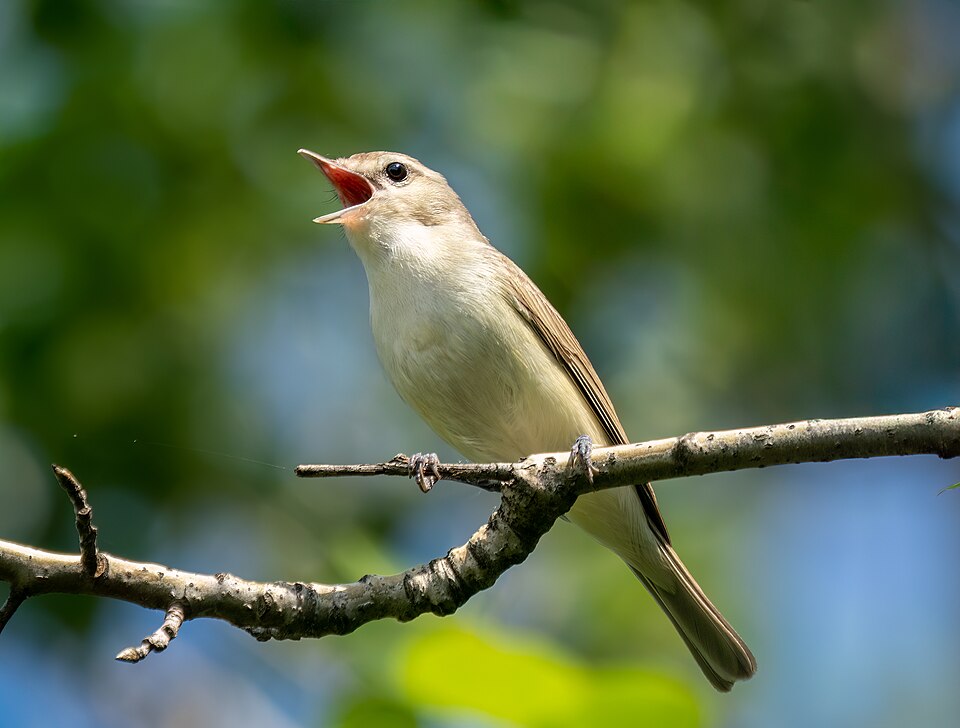
The Warbling Vireo is one of those birds that teaches you to use your ears. Drab and unmarked, it slips through the leafy canopy of riverside cottonwoods and shade trees where it can be maddeningly hard to spot. But its song gives it away: a long, rolling, slightly slurred warble that bubbles down from the treetops all through late spring and summer. Once you learn that tune, you suddenly realize this little gray-olive songbird is everywhere across much of North America.
Found from coast to coast in summer, the Warbling Vireo favors deciduous woodland edges, streamside groves, parks, and tree-lined neighborhoods. It is not a flashy bird, and it will never visit your feeder, but it is one of the most widespread and persistent singers of the warm months. For birders, it is a rite of passage: the moment you stop searching for field marks and start identifying a bird purely by voice.
This is a small, compact songbird with a notably plain appearance and a stout, slightly hooked vireo bill. Its shape is chunkier and its movements slower and more deliberate than a warbler's. The overall impression is of a gray-and-olive bird with very few marks, which is itself the key field clue.
| Overall color | Plain grayish above with a subtle olive wash, palest and whitish below, sometimes faintly yellow on the flanks (more so in fall and in western birds) |
| Face pattern | A pale whitish eyebrow stripe (supercilium) above a dark line through the eye; no eyering and no wing bars |
| Wing bars | None, a clean, unmarked wing, which separates it from many similar warblers and vireos |
| Bill | Short, thick, and slightly hooked at the tip, typical of vireos and stouter than a warbler's |
| Eye | Dark eye set off by the pale eyebrow; lacks the bold white spectacles of some relatives |
| Crown | Gray crown that can contrast slightly with a more olive back |
Male vs. female
Males and females look alike. There is no reliable visual difference between the sexes in the field, both show the same plain gray-olive plumage, pale eyebrow, and unmarked wings. In practice, the singing bird is usually the male, since males do most of the persistent territorial warbling, though females sing occasionally too.
Juveniles
Freshly fledged juveniles look much like adults but tend to be a bit fresher and cleaner, often with a slightly buffier or warmer wash and softer-edged plumage. Fall birds of all ages frequently show more yellow on the sides and flanks than worn summer adults, which can briefly confuse identification before the song or overall plainness sorts it out.
The song is the signature of this bird: a long, rambling, musical warble that tumbles up and down and characteristically rises at the very end, as if the bird asks a quick question. Many birders learn it with the old mnemonic "If I sees you, I will seize you, and I'll squeeze you till you squirt!", the phrase captures the run-on, energetic, finishing-with-a-flourish quality of the song. It is sweeter and more continuous than the choppy, pause-filled phrases of the Red-eyed Vireo.
Calls include a nasal, slightly buzzy or whining note, often rendered as a downslurred tsee or a harsher scolding series when the bird is agitated. Males sing persistently through the heat of summer, even at midday when most other songbirds fall silent, which makes the species a reliable summer voice long after the spring chorus fades.
The Warbling Vireo is a long-distance migrant that breeds widely across North America, from the Pacific Northwest and California across the northern and central United States and well up into Canada, reaching east to New England and the mid-Atlantic. It is largely absent as a breeder from the Deep South. There is a recognized split in character between eastern and western populations, with western birds tending to be a touch smaller and showing subtly different song and tone.
It winters in Mexico and Central America, vacating its breeding range entirely. Expect arrivals in much of the United States in late April and May, a long singing season through summer, and a southbound departure through late August and September.
Through the breeding season the Warbling Vireo is overwhelmingly insectivorous. It gleans caterpillars, beetles, true bugs, aphids, and other small invertebrates from leaves and twigs, working methodically through the foliage of the canopy and mid-story. Caterpillars are an especially important food, and the bird's deliberate, leaf-by-leaf foraging style is well suited to finding them.
Its movements are slower and more peering than the hyperactive flitting of warblers, it tends to hop along branches and inspect the undersides of leaves rather than dart about. In late summer and fall, as on the wintering grounds, it adds small fruits and berries to the diet to fuel migration.
The nest is a neat, deep little cup suspended hammock-style from a forked branch, typically well up in a deciduous tree such as a cottonwood, willow, maple, or aspen near water or along a woodland edge. Both members of the pair build it, weaving grasses, bark strips, plant fibers, and spider silk into the fork and often decorating the outside with lichen or bits of plant down.
The female typically lays three to five white eggs lightly spotted with brown or black. Both parents share incubation, unusual among songbirds for the male to take a real turn on the eggs, and both feed the nestlings. Warbling Vireos are frequent hosts to Brown-headed Cowbirds, which lay their eggs in vireo nests; the smaller vireos often end up raising the larger cowbird chick at a cost to their own young.
The Warbling Vireo is not a feeder bird and will not be tempted by seed, suet, or nectar. It is an insect-eating canopy specialist, so the way to "attract" one is to offer the kind of habitat it needs rather than food at a station. If you have tall deciduous trees nearby, your best tool is a good ear in late spring and summer.
- Keep tall deciduous trees, cottonwoods, willows, maples, and aspens, especially near water, are the habitat this species seeks out.
- Garden for insects, not seed: avoid broad pesticide use so caterpillars and other prey remain abundant in your trees.
- Add a water feature; like many woodland birds, vireos are drawn to streamside and riparian settings and will use clean water nearby.
- Learn the song, the rolling warble that rises at the end is how you will actually find this bird in your neighborhood trees.
- Plant native fruiting shrubs for late summer, when migrating vireos add berries to their diet.
- Look up, not down: scan the leafy canopy and mid-story rather than expecting the bird at eye level or on the ground.
- Red-eyed Vireo: Bolder face with a gray crown, black-bordered white eyebrow, and (in adults) a red eye; sings choppy, separated phrases rather than one continuous warble.
- Philadelphia Vireo: Very similar shape but shows distinct yellow on the throat and breast (strongest at the center), and a dark line through the eye reaching the bill; song is slower and more like a Red-eyed Vireo's phrases.
- Tennessee Warbler: Also plain with a pale eyebrow, but has a thin, sharp warbler bill, more active foraging, and a sharp staccato song; often shows cleaner white undertail.
- Bell's Vireo: Smaller and scrubbier-habitat bird with a faint eyering, often two weak wing bars, and a distinctive husky, hurried song that ends with an up or down note.
What does a Warbling Vireo look like?
It is a small, plain songbird, gray above with an olive tinge and whitish below, sometimes with faint yellow on the flanks. The best marks are what it lacks: no wing bars and no eyering, just a pale whitish eyebrow stripe over a dark eye-line, and a short, slightly hooked vireo bill.
How do I tell a Warbling Vireo from a Red-eyed Vireo?
Look at the face and listen to the song. The Red-eyed Vireo has a sharply marked gray crown and a black-bordered white eyebrow, while the Warbling Vireo's face is much softer and plainer. By voice, the Warbling Vireo gives one long, tumbling, continuous warble, whereas the Red-eyed Vireo sings short, separate phrases with pauses between them.
What does the Warbling Vireo's song sound like?
A long, rolling, musical warble that runs up and down and tends to rise at the very end. A classic memory aid is the phrase 'If I sees you, I will seize you, and I'll squeeze you till you squirt!' which mimics the run-on rhythm and the energetic finish.
Will Warbling Vireos come to a bird feeder?
No. They are insect eaters that forage high in the canopy and do not visit seed, suet, or nectar feeders. The way to attract them is to provide tall deciduous trees, avoid pesticides so caterpillars remain plentiful, and ideally have water nearby.
Where and when can I find a Warbling Vireo?
They breed across much of North America from late April or May through summer, favoring tall deciduous trees along rivers, woodland edges, parks, and leafy neighborhoods. They migrate to Mexico and Central America for winter, so listen for their persistent song from spring arrival until they depart in late summer and early fall.