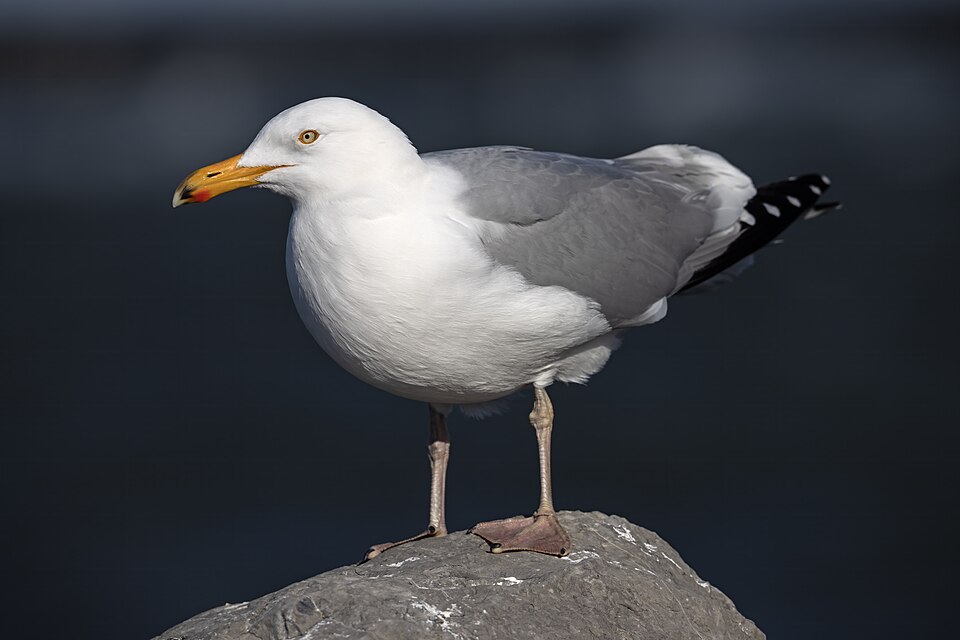
If you picture a "seagull" in your mind, you are probably picturing a Herring Gull. This large, sturdy gull is the default big gull across much of the Northern Hemisphere, equally at home patrolling a harbor, loafing on a supermarket parking lot, or wheeling over a Great Lakes beach. Adults are clean and handsome up close, with a pale gray back, snowy white head and underparts, and a heavy yellow bill marked by a single red spot near the tip. That red spot is famous in animal behavior textbooks: chicks peck at it to beg, and parents respond by coughing up food.
Herring Gulls are the quintessential opportunists. They are smart, adaptable, long-lived, and not remotely shy around people, which is exactly why they thrive in landscapes we have heavily altered. Their numbers boomed through the 20th century alongside fishing fleets and open landfills, and although some regional populations have since declined as dumps closed, they remain one of the most familiar and easily watched birds in North America and Europe. For backyard birders, they are less a feeder visitor than a constant presence overhead and a great bird for learning the tricky art of gull identification.
A Herring Gull is a big, broad-chested gull with a fairly heavy, slightly bulbous-tipped bill and a flat-crowned, businesslike head. It takes four years to reach full adult plumage, so at any given time a flock holds a confusing mix of gray-and-white adults and brown, mottled younger birds. Start with the legs and bill of adults, then learn the brown juveniles separately.
| Back & wings | Adults pale gray (mantle) with black wingtips marked by small white spots ('mirrors') |
| Legs | Dull pink, a key separator from yellow-legged gulls |
| Bill | Heavy and yellow with a red spot near the tip of the lower mandible |
| Eye | Pale yellow iris with an orange-yellow ring, giving a fierce, staring expression |
| Head (winter) | White but heavily streaked with brown, especially around the neck and nape |
| Size | Large, noticeably bigger and bulkier than a Ring-billed Gull |
Male vs. female
Males and females look alike in plumage, both show the same gray back, white body, pink legs, and red-spotted yellow bill. The only consistent difference is size: males average larger and heavier-billed, with a blockier head, while females tend to look a bit smaller and finer-featured. This is only obvious when a pair stands side by side, and there is plenty of overlap, so you generally cannot reliably sex a lone bird in the field.
Juveniles
Young Herring Gulls look nothing like the clean gray adults, and this trips up countless birders. A first-year bird is overall mottled brown, with a dark, all-black bill, dark eyes, and dusky pink legs. Over the next three years it gradually whitens: the head and underparts pale, gray feathers grow in on the back, the bill starts yellowing from the base with a black tip, and the tail loses its dark band. By the fourth winter it finally matches the adult. The whole sequence, dark juvenile to clean adult, is why a single flock can look like several different "species" at once.
The Herring Gull's voice is the sound of the seaside itself. The signature call is the "long call," a loud, ringing series that starts with a few low notes and rises into a bugling, laughing crescendo, kyow-kyow-kyow-kee-ah-kee-ah-kee-ah, often delivered with the head thrown back and then jerked forward. It is the cry filmmakers reach for whenever they want to say "we are at the coast."
They have a wide vocabulary beyond that. Listen for a sharp, repeated alarm kee-yah or gah-gah-gah, a soft mewing call between mates, and a nasal, anxious note around the nest. Begging chicks and juveniles give a thin, whistled klee-ew. The overall tone is bold and far-carrying, fitting for such a confident bird.
Herring Gulls breed across northern North America, from the Atlantic coast of New England and the Canadian Maritimes west across the boreal lakes of Canada and into Alaska, plus locally around the Great Lakes. A closely related complex of birds occupies northern Europe and Asia. In winter, North American birds spread south and become abundant along both coasts, the Great Lakes, the Gulf of Mexico, and increasingly inland along big rivers, reservoirs, and around landfills.
They are partial migrants: northern breeders move south to escape ice, while birds in milder coastal areas may stay put year-round. Outside the breeding season you can find them almost anywhere there is open water and a food source, which is why winter brings them to inland spots far from any ocean.
Herring Gulls eat almost anything. Their natural diet leans on fish, crabs, marine worms, sea urchins, mussels, and other shellfish, plus the eggs and chicks of other birds when they can get them. They are famous for dropping hard-shelled clams and mussels onto rocks, pavement, or roads from a height to crack them open, then dropping again if the first try fails, a genuinely clever behavior.
Around people they become consummate scavengers, working harbors for fishing scraps, following plows for exposed grubs, raiding picnic tables and trash cans, and historically swarming open landfills in huge numbers. They also forage by surface-dipping, shallow plunging, walking the tideline, and stealing food from other birds. This dietary flexibility is the engine behind their success.
Herring Gulls nest in colonies, usually on coastal islands, rocky shores, cliff ledges, dunes, or increasingly on flat city rooftops. Both members of a long-term pair build a nest on the ground, a scrape lined with grass, seaweed, and debris. The female typically lays three olive-to-buff eggs blotched with brown, which camouflage well among the vegetation.
Both parents share incubation for roughly four weeks. The downy, mottled chicks can walk soon after hatching but stay near the nest, pecking at the parents' red bill spot to trigger feeding. Adults defend the territory fiercely, dive-bombing intruders, including people, that wander too close. There is one brood per year, and young gulls take four years to mature, with many living well over a decade in the wild.
The Herring Gull is not a backyard feeder bird in any traditional sense, you will not lure it with a seed feeder or a suet cage, and deliberately feeding gulls is generally a bad idea that creates bold, aggressive birds and angry neighbors. Still, if you live near the coast or a large lake, you can reliably watch and appreciate them with a little effort.
- Go to the water. Harbors, fishing piers, beaches, lake shores, and reservoir edges are the dependable places to find them up close.
- Visit at the right time. Numbers and variety peak in winter, when migrants pile in alongside other gull species, perfect for ID practice.
- Bring binoculars and a scope. Gull identification rewards a careful look at leg color, bill markings, eye color, and wingtip pattern.
- Do not feed them. Tossing fries trains gulls to mob people and damages their health, watch, don't feed.
- Check parking lots and landfills (from a distance). Big-box store lots, dumpsters, and dump perimeters often hold loafing flocks worth scanning.
- Ring-billed Gull: Smaller and daintier with yellow legs and a neat black ring around the bill instead of a red spot.
- Great Black-backed Gull: Much larger with a blackish (not pale gray) back and a more massive bill; pink legs like the Herring.
- Lesser Black-backed Gull: Darker slate-gray back and yellow legs (Herring has pink legs); slimmer build.
- California Gull: Smaller with greenish-yellow legs, a dark eye, and a black-and-red mark on the bill.
Is a 'seagull' the same as a Herring Gull?
There is no actual bird called a 'seagull', it's a catch-all term for gulls. The Herring Gull is the species most people picture when they say 'seagull,' especially in North America and Europe, because it's the big, bold, pink-legged gull found around coasts, harbors, and lakes.
Why do Herring Gulls have a red spot on their bill?
The red spot is a feeding signal. Chicks instinctively peck at it to beg for food, which prompts the parent to regurgitate a meal. It's one of the most famous examples of an animal 'releasing' a fixed behavior, studied in classic experiments by Niko Tinbergen.
How can I tell a Herring Gull from a Ring-billed Gull?
Size and color give it away. Herring Gulls are noticeably larger with pink legs and a yellow bill marked by a red spot. Ring-billed Gulls are smaller with yellow legs and a clean black ring around the bill rather than a red spot.
Why are some 'Herring Gulls' brown instead of gray?
Those are young birds. Herring Gulls take four years to reach adult plumage, so first- and second-year birds are mottled brown with dark bills. They gradually whiten and grow gray back feathers each year until they match the clean gray-and-white adult.
Are Herring Gulls aggressive toward people?
They can be, especially around their rooftop or beach nests, where they may dive-bomb to drive away intruders. They're also bold around food and will snatch unguarded snacks. They aren't dangerous, but it's best to keep your distance from nests and never feed them.