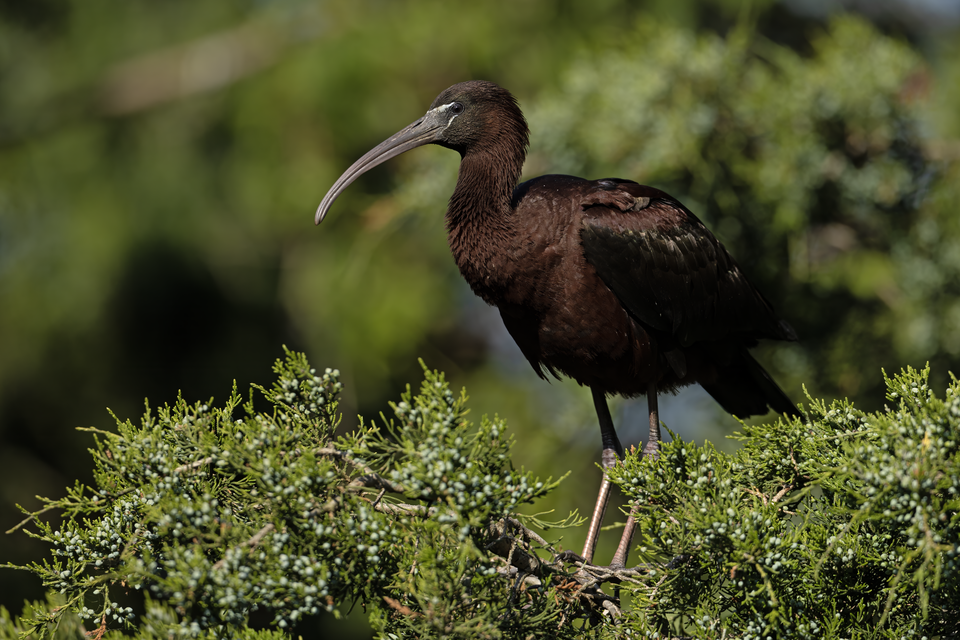
The Glossy Ibis looks plain dark brown from a distance, but catch one in good sunlight and it transforms. The body glows deep chestnut and maroon, while the wings and back flash bottle-green, bronze, and violet. Add a long, slender, downcurved bill and a leggy, stalking gait, and you have one of the most elegant wading birds in the marsh. It is the most widespread ibis on Earth, found across parts of Europe, Africa, Asia, Australia, and the Americas.
In North America, the Glossy Ibis is mainly a bird of the Atlantic and Gulf coasts, favoring freshwater and brackish marshes, flooded fields, rice impoundments, and the edges of coastal wetlands. It often feeds in loose flocks, probing soft mud with that sensitive bill, and roosts and nests in colonies alongside herons, egrets, and other ibises. Patient and quiet, it rewards birders who scan the back edges of a marsh where the light angles just right.
This is a medium-sized, long-legged wading bird with a distinctive profile: a slim, evenly downcurved bill, a long neck often held in a gentle S-curve, and a slender body. In flight it shows a profile unlike a heron's, holding its neck outstretched rather than tucked, with quick wingbeats interspersed with glides.
| Overall color | Looks dark at a distance; in sunlight rich chestnut-maroon body with iridescent green, bronze, and purple wings and back |
| Bill | Long, slender, evenly downcurved; dull grayish to brownish |
| Face | In breeding adults, a thin pale blue-gray line of bare skin borders the face but does NOT connect across the forehead or behind the eye |
| Eye | Dark brown (a key separator from the red-eyed White-faced Ibis) |
| Legs | Long, grayish to greenish; reddish at the joints in breeding birds |
| In flight | Neck and legs outstretched, fast shallow wingbeats with short glides, often in lines or loose V formations |
Male vs. female
Males and females look essentially identical in plumage and color, so you cannot reliably sex them in the field. Males average slightly larger with a marginally longer bill, but this overlap is wide and only obvious when a pair stands side by side. There is no seasonal plumage difference between the sexes either.
Juveniles
Juveniles and immatures are much duller than adults. They are a sooty grayish-brown overall with only a faint greenish gloss on the wings, and the head and neck are often streaked or speckled with whitish flecks rather than showing the warm chestnut tones of breeding adults. The bare facial skin is dull and inconspicuous. Young birds gradually acquire adult iridescence over their first year or two, so a drab-looking ibis in late summer or fall is very often a bird of the year.
The Glossy Ibis is a mostly quiet bird, which is part of why it can be easy to overlook. When it does call, it gives low, guttural, almost grunting sounds, often rendered as a nasal grunk or a rolling graa-graa-graa. Around the colony and in flight you may hear soft croaks, bleats, and pig-like grunts as birds jostle and communicate.
There is no musical song here. Compared to the constant squawking of a heron colony, ibises are subdued, and away from breeding sites you may watch a flock feed for a long time without hearing a sound.
Globally this is the most cosmopolitan of all ibises, breeding across southern Europe, Africa, southern Asia, Australia, and the warmer parts of the Americas. In North America its stronghold is the Atlantic Coast from the mid-Atlantic states south through Florida and along the Gulf Coast, with smaller and expanding numbers inland and on the Caribbean islands.
Northern breeders are partly migratory, withdrawing south in fall to winter along the Gulf Coast, Florida, and the Caribbean, while birds in milder climates stay put year-round. The species is known for dramatic wandering, and the North American population is thought to have originated from birds that crossed from Africa to South America and then spread north. Vagrants turn up well outside the expected range with some regularity.
The Glossy Ibis is a tactile feeder. It walks slowly through shallow water and soft mud, probing repeatedly with its long curved bill, detecting prey by touch rather than sight. This lets it forage productively even in murky water or among dense vegetation.
Its diet is dominated by aquatic and marsh invertebrates: insects and their larvae, crayfish and other crustaceans, snails, worms, leeches, and aquatic beetles. It will also take small fish, frogs, tadpoles, and the occasional small snake. In flooded agricultural fields, especially rice and crayfish ponds, it readily exploits abundant insects and crustaceans, which is one reason it has thrived alongside certain kinds of farming.
Glossy Ibises nest in colonies, frequently mixed with herons, egrets, and other ibis species, in trees, shrubs, or reedbeds standing over or near water. The nest is a platform of sticks, reeds, and other plant material, built low in vegetation or in the canopy depending on the site. Both members of a pair contribute, with the male often gathering material and the female doing much of the construction.
The female typically lays three to four pale blue-green eggs. Both parents share incubation over roughly three weeks, and both feed the chicks by regurgitation. Young birds clamber around branches near the nest before they can fly and fledge a few weeks after hatching. Pairs generally raise a single brood per season.
The Glossy Ibis is not a backyard or feeder bird, and there is no realistic way to draw one to a typical yard. It is a colonial wetland specialist that needs shallow water, soft mud, and abundant invertebrate prey. That said, if you want to see or support them, there are productive things you can do.
- Visit coastal and freshwater marshes, flooded fields, and managed wetland impoundments at wildlife refuges, especially along the Atlantic and Gulf coasts, where ibises feed in the open.
- Look at the edges and back corners of marshes in early morning or late afternoon, when low-angle sunlight reveals the iridescence that gives the bird its name.
- If you own or manage wetland or farmland, maintaining shallow flooded areas free of heavy pesticide use supports the insects and crustaceans ibises depend on.
- Watch rice and crayfish farming areas in the Gulf states, where Glossy Ibises often gather in numbers to feed.
- Support wetland conservation and land-trust efforts, since healthy colonial nesting sites and feeding marshes are what this species truly needs.
- White-faced Ibis: Nearly identical, but breeding adults have a broad white feathered border that wraps fully around the face (behind the eye and across the forehead), a red eye, and reddish legs. Glossy has a thin blue-gray bare line that does NOT encircle the face, and a dark eye. They overlap and can hybridize where ranges meet.
- White Ibis: Adults are unmistakably white with a red, downcurved bill and black wingtips. Only confusion is with brown-and-white immature White Ibis, which still show a white belly and pinkish bill, never the all-dark iridescent body of a Glossy.
- Glossy Ibis vs. herons: Dark herons can look superficially similar, but a heron has a straight, dagger-like bill and flies with its neck tucked back. The ibis has a long curved bill and flies with neck outstretched.
How do you tell a Glossy Ibis from a White-faced Ibis?
Check the face and eye. A breeding White-faced Ibis has a band of white feathers fully encircling the face (around the back of the eye and across the forehead) and a red eye with reddish legs. A Glossy Ibis has only a thin blue-gray line of bare skin bordering the face that does not wrap all the way around, and it has a dark brown eye. Outside of breeding season the two are extremely difficult to separate.
Is the Glossy Ibis actually glossy?
Yes, though only in good light. From a distance or under overcast skies it looks plain dark brown. When the sun hits it, the body glows chestnut-maroon and the wings and back flash iridescent green, bronze, and purple, which is exactly how it earned its name.
Where can I see a Glossy Ibis in the United States?
They are most common along the Atlantic Coast from the mid-Atlantic states south to Florida, and along the Gulf Coast. Look in coastal and freshwater marshes, flooded fields, rice and crayfish impoundments, and the shallow edges of wetland wildlife refuges, especially in spring and summer.
What does a Glossy Ibis eat?
It is a touch-feeder that probes mud and shallow water with its long curved bill. Its diet is mainly aquatic invertebrates such as insects, crayfish, snails, worms, and aquatic beetles, plus occasional small fish, frogs, and tadpoles.
Will a Glossy Ibis come to my backyard or feeder?
No. This is a colonial wetland bird that needs shallow water, mud, and abundant invertebrate prey. It does not visit feeders or typical yards. To see one, head to a coastal or freshwater marsh rather than waiting at home.