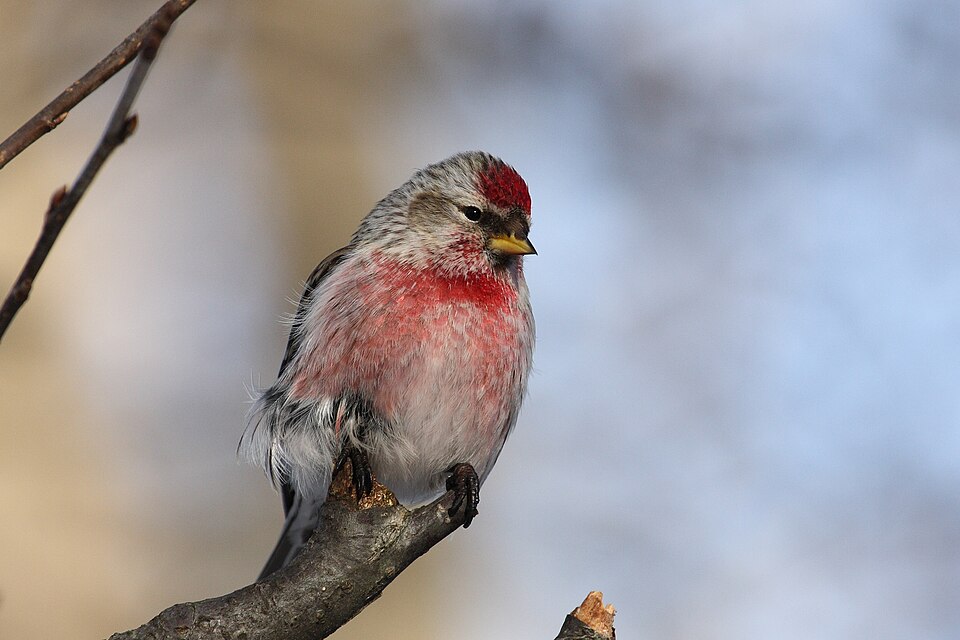
The Common Redpoll is a sparrow-sized finch built for cold. It breeds across the open tundra and stunted boreal scrub of the high Arctic, where few songbirds can make a living, and survives temperatures that would kill most birds its size. Streaky brown overall with a neat crimson cap on the forehead and a small black chin patch, it is easy to overlook until a flock descends on a stand of birches or a feeder full of nyjer seed and the whole group erupts into a chattering, restless cloud.
For birders south of the boreal forest, the redpoll is a prize of certain winters and an absence in others. In "irruption" years, when the Arctic birch and alder seed crop fails, redpolls pour south into the northern United States in large numbers, sometimes by the hundreds. In other years they stay north and barely cross the border. That boom-and-bust rhythm is part of what makes them so beloved: spotting your first flock of the season feels like a small reward for sticking out a long winter at the window.
Redpolls are small, round, energetic finches with short notched tails and stubby, conical yellow bills. In a flock they look like animated brown streaks until you catch the field marks: a bright red forehead patch, a black chin, and (on many birds) a soft pink wash across the breast. They cling acrobatically to seed heads, often hanging upside down like chickadees.
| Red cap | Bright crimson-red patch on the forehead (the "poll"), present on both sexes and most ages |
| Black chin | Small, neat black bib directly under the bill - a key mark separating redpolls from other streaky finches |
| Bill | Short, sharply pointed, conical, and yellowish with a dark tip; built for extracting tiny seeds |
| Body | Brown-and-buff streaking above and on the flanks, with two pale wing bars and a notched tail |
| Breast color | Males show a rosy-pink to red wash across the breast; females and young birds are whiter or buff below |
| Size | Tiny - smaller than a House Finch, similar in bulk to an American Goldfinch |
Male vs. female
Both sexes wear the red cap and black chin, so those marks alone won't tell them apart. The clearest difference is the breast: adult males show a rosy to raspberry-pink wash across the chest and often a flush on the cheeks and rump, brightest in fresh spring plumage. Females and immature birds lack the pink, showing a whiter or buff breast with crisp dark streaking on the flanks. In a mixed winter flock you can often pick out the "pink-fronted" males at a glance, while everything else is the grayer-and-browner crowd.
Juveniles
Juvenile redpolls just out of the nest are heavily streaked and at first lack the red cap and black chin, looking like nondescript little brown finches. By their first winter, young birds have acquired the red forehead and dark chin and closely resemble adult females, with a buffy, well-streaked breast and no pink. Telling a first-winter bird from an adult female in the field is genuinely difficult, so most birders simply log them as "female-type" redpolls.
Redpolls are noisy, sociable birds, and you'll usually hear a flock before you see it. The most distinctive sound is the flight call, a dry, buzzy, rattling chit-chit-chit-chit given as the birds bound overhead in tight bouncing flocks. Mixed in is a rising, querulous swee-eet? or dzwee that has an almost questioning tone.
The song, heard mostly on the breeding grounds and occasionally from wintering birds in late winter, strings these elements together: a loose, twittering series of trills and buzzes interspersed with the rattling call notes, delivered in a rambling, unhurried jumble. It is pleasant but not musical in the way a goldfinch is - more of a chattery, electric warble than a true melody.
Common Redpolls breed in a band across the high latitudes of North America and Eurasia, in the Arctic tundra, willow and birch scrub, and the northern edge of the boreal forest. In North America that means northern Alaska and across northern Canada. They are circumpolar, so the same species (or close relatives) breeds across northern Scandinavia, Russia, and Siberia.
In winter they retreat south, but how far depends entirely on the northern seed crop. Most winters they reach southern Canada and the northern tier of the United States. In irruption years - typically every other winter, tracking failures in the birch and alder seed supply - they push much farther south, sometimes reaching the central states. Numbers and locations are notoriously unpredictable, which is why birders watch redpoll movements as one of the great wildcards of the winter season.
Redpolls are seed specialists with a particular love of small catkin-bearing trees. In winter their staple foods are the tiny seeds of birch and alder, which they extract by clinging to the dangling catkins and working them over with their pointed bills, often hanging upside down. They also take seeds of weeds and grasses and readily visit feeders. At feeders, nyjer (thistle) seed and hulled or fine sunflower are the big draws.
They are remarkably cold-adapted feeders. A redpoll can stuff seeds into an expandable pouch in its throat (the esophageal diverticulum), then retreat to a sheltered perch and digest the cache slowly through the long Arctic night - an adaptation that lets it survive extreme cold by feeding fast at dusk. In summer they add insects to the diet, especially for feeding nestlings.
Redpolls nest in the short shrubs, dwarf willows, and stunted spruces of the tundra and far north, usually placing the nest low to the ground for shelter from the wind. The female builds a compact cup of fine twigs, grass, and rootlets, then lines it thickly with feathers, plant down, and animal hair for insulation against the cold - essential when raising young in a climate that can freeze even in the brief summer.
She lays a clutch of pale blue-green eggs lightly speckled with reddish-brown and does the incubating herself, while the male brings food. Because the Arctic breeding season is so short, pairs work quickly, and in good years they may raise two broods. Young are fed regurgitated seeds and insects and fledge in a couple of weeks.
Yes - in the right winter, redpolls are excellent feeder birds, and they can arrive in flocks that turn your feeder into a chattering swarm. The catch is that you only get them in irruption years, so the goal is to be ready when they move south.
- Offer nyjer (thistle) seed in a finch feeder or mesh sock - it's the single best draw for redpolls and goldfinches alike
- Provide fine or hulled sunflower and sunflower chips, which redpolls take readily alongside nyjer
- Use feeders with plenty of perching room (tube feeders, mesh socks, or trays) since redpolls arrive in flocks and feed shoulder to shoulder
- Plant or keep birch and alder trees if you can - their catkins are a natural magnet and may pull birds in even without a feeder
- Keep feeders stocked through midwinter in the northern U.S. and Canada, especially during a known irruption year, so birds find your yard when they pass through
- Don't be discouraged in off years - redpoll visits are cyclical, and an empty winter is normal, not a feeder problem
- Hoary Redpoll: Frostier and paler overall with less streaking, a smaller bill, and an unstreaked or barely streaked white rump and undertail; often travels in the same flocks and can be very hard to separate.
- Pine Siskin: Similar size and streaky brown body, but lacks the red cap and black chin; instead shows yellow flashes in the wings and tail and a thinner, more pointed bill.
- House Finch: Larger and chunkier, with red concentrated on the face, throat, and rump rather than a neat forehead cap, and no black chin patch.
- American Goldfinch: Winter birds are drab and streaky like redpolls but show plain (unstreaked) buff underparts, no red cap, and bolder wing bars.
What is the difference between a Common Redpoll and a Hoary Redpoll?
Hoary Redpolls look frostier and paler, with less streaking on the flanks, a stubbier bill, and a clean white (unstreaked) rump and undertail. Common Redpolls are browner and more heavily streaked with a longer bill. The two often mix in the same flock and can be genuinely difficult to tell apart, since they form a continuum - in fact many authorities now treat them as a single species.
Why do redpolls show up some winters but not others?
Redpolls are an irruptive species. Their movements track the seed crop of Arctic birches and alders. When that crop fails up north, large numbers push south in search of food (an irruption year); when seed is plentiful, they stay north. This boom-and-bust cycle is why you might host flocks one winter and see none the next.
What do redpolls eat at feeders?
Nyjer (thistle) seed is the top choice, offered in a finch tube feeder or a mesh sock. They also eagerly take fine or hulled sunflower and sunflower chips. Because they arrive in flocks, feeders with lots of perching space attract and hold them best.
How do redpolls survive Arctic winters?
They are among the most cold-hardy songbirds. They have dense plumage, feed rapidly at dusk, and store seeds in an expandable throat pouch so they can digest food slowly overnight while roosting in sheltered spots, sometimes even tunneling into the snow for insulation.
Are male and female redpolls different colors?
Both sexes have the red forehead cap and black chin, so those don't distinguish them. The reliable difference is the breast: adult males show a rosy-pink to red wash across the chest, while females and young birds have a whiter or buff, streakier breast with no pink.