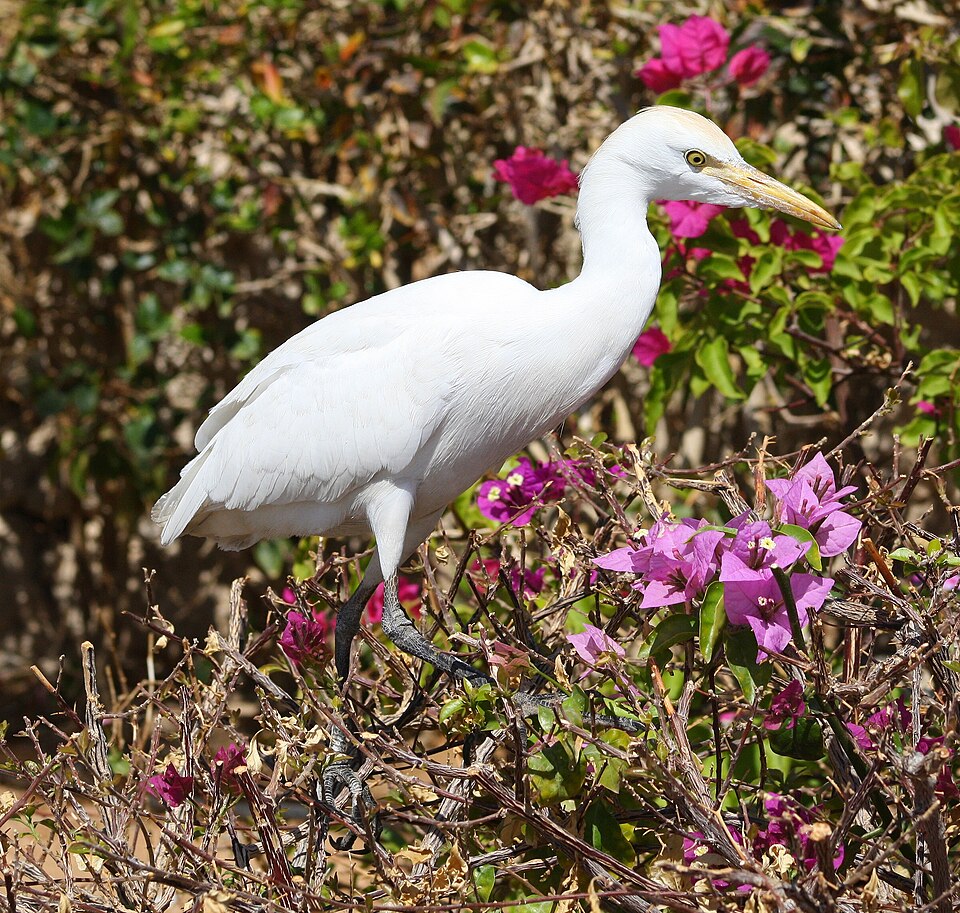
The Cattle Egret is one of the great success stories of the bird world. A small, stocky white heron with a hunched posture and a thick neck, it is most famous for the company it keeps: cattle, horses, water buffalo, tractors, and any other large animal that stirs up insects as it moves. Where most herons are tied to water, the Cattle Egret made its living in pastures and grasslands, walking among grazing livestock and snapping up the grasshoppers, flies, and frogs flushed out underfoot. That partnership turned out to be a ticket to nearly every continent.
Originally native to Africa, southern Europe, and Asia, the Cattle Egret crossed the Atlantic on its own, reaching South America in the late 1800s and arriving in North America by the 1940s and 1950s. It spread astonishingly fast, following the expansion of agriculture, and now breeds across much of the United States, with populations on every continent except Antarctica. For backyard birders, it is a familiar sight in farm country, along highway medians, and behind mowers, even when no open water is in view.
Cattle Egrets are the chunkiest and shortest of the common white herons in North America. Look for a compact, jowly bird with a short, thick neck often tucked into a hunched profile, relatively short legs, and a stout bill. In bright breeding plumage they take on warm buffy color that no other white egret shows.
| Size & shape | Small, stocky heron with a thick neck and rounded, jowly head; noticeably shorter and dumpier than a Snowy or Great Egret. |
| Plumage | All white in basic plumage; breeding adults flush buffy-orange on the crown, breast, and back (the so-called nuptial plumes). |
| Bill | Short, thick, and yellow most of the year, turning bright orange or reddish at the height of breeding. |
| Legs & feet | Greenish-yellow to dark legs (no contrasting bright feet); during peak breeding the legs can flush reddish. |
| Posture | Hunched, neck pulled in, often walking actively rather than standing still and stalking. |
| Habitat clue | Frequently away from water, in pastures and fields, often right beside cattle or following farm machinery. |
Male vs. female
Males and females look essentially alike, and you cannot reliably tell them apart in the field. Males average slightly larger and tend to develop somewhat fuller and more vivid buff plumes during the breeding season, but the overlap is too great to call individual birds by sex. Both sexes show the same white body, short yellow bill, and the warm buff wash on the head, chest, and back when in breeding condition.
Juveniles
Juvenile Cattle Egrets are entirely white with no buff coloring, looking like washed-out versions of the adults. Their bills start out dark or blackish and gradually turn yellow as they mature, and their legs are dark. A young Cattle Egret with a dark bill can briefly puzzle observers, but its stocky shape, short neck, and pasture-following habits give it away.
Cattle Egrets are mostly silent away from the breeding colony, which is part of why they are so easy to overlook as anything but a quiet white shape in a field. Around the nest and roost, though, they become quite vocal and noisy. The typical sound is a low, throaty croak often written as rick-rack or a short rok-rok, sometimes given as a stuttering series.
At a busy heronry the overall effect is a constant hoarse, frog-like grumbling and croaking as birds jostle for space and greet mates. They also give softer, guttural calls during courtship displays. None of it is musical, but the raspy chorus of a colony is unmistakable once you have heard it.
The Cattle Egret has one of the widest ranges of any heron, found across Africa, southern Europe, Asia, Australia, and the Americas. In North America it breeds widely across the southern and eastern United States, with concentrations in the Southeast, Gulf Coast, California's Central Valley, and the lower Mississippi Valley, and it has pushed north into the interior in summer.
Movement is partly migratory and partly dispersive. Northern breeders withdraw south for the winter, and many North American birds winter in the southern U.S., Mexico, the Caribbean, and Central America. After the breeding season young birds famously wander, sometimes turning up far outside the normal range, which is exactly how the species colonized so much of the world in the first place.
Unlike most herons, the Cattle Egret is primarily a land forager. Its diet is dominated by insects, especially grasshoppers, crickets, flies, beetles, and moths, supplemented with spiders, frogs, lizards, small snakes, earthworms, and the occasional small mammal or nestling bird. It eats far fewer fish than its waterbird relatives.
Its signature feeding strategy is to follow large grazing animals, walking alongside cattle, horses, or buffalo and grabbing the insects and small prey their hooves flush from the grass. Studies show egrets feeding with livestock catch more food with less effort than those foraging alone. They readily adapt this trick to human machinery, gathering behind tractors, mowers, and plows, and they also patrol burned fields, lawns, and roadsides for displaced prey.
Cattle Egrets are colonial nesters, breeding in noisy mixed heronries alongside other egrets, herons, and ibises, usually in trees or shrubs over or near water, on islands, or in dense thickets. The male establishes a display territory and courts females with stretching displays, plume-raising, and bill-clattering; the buffy breeding plumes and bright bill and leg colors are all part of the show.
The nest is a fairly flimsy platform of sticks and twigs, with the male gathering most of the material and the female doing much of the building. Both parents share incubation and feeding of the young. The pale blue-green eggs hatch after roughly three to four weeks, and the chicks are fed regurgitated food, fledging over the following several weeks.
The Cattle Egret is not a backyard feeder bird, and no seed, suet, or nectar will bring one in. It feeds on live insects and small animals flushed from grass, so the way to "attract" it is really to provide the open foraging habitat it likes rather than a feeder.
- You will not draw Cattle Egrets with feeders or birdseed, they hunt live insects and small prey, not seeds.
- If you have acreage with grazing livestock, expect egrets to find the herd on their own; they are drawn to the insects the animals stir up.
- Large mowed areas, pastures, and recently cut or lightly grazed fields create the open, insect-rich ground they prefer.
- Avoiding broad insecticide use keeps the grasshopper and cricket populations they depend on intact.
- Nearby trees or shrubs over water can support a heronry, but colonies form on their own terms and should never be disturbed.
- Watch for them along highway edges, ballfields, and behind tractors, open grassy areas near you are your best bet for a sighting.
- Snowy Egret: More slender and elegant with a thin black bill, black legs with bright yellow feet, and lacy plumes; stalks in shallow water rather than following livestock.
- Great Egret: Much larger and lankier with a long neck, long black legs, and a long yellow bill; a stately water hunter, not a pasture bird.
- Little Blue Heron: Immatures are all white but show a two-toned bluish bill with a dark tip and greenish legs, and they forage methodically in wetlands.
- Great White Egret: The Old World name for the Great Egret; far bigger and longer-necked than the stocky Cattle Egret, and tied to water.
Why do Cattle Egrets follow cattle?
As cattle, horses, and other large grazers walk through grass, their hooves flush out grasshoppers, crickets, flies, and other small prey. The egrets walk alongside and snap up these disturbed insects, which lets them catch more food with far less effort than hunting alone. They use the same trick behind tractors and mowers.
Are Cattle Egrets native to North America?
No. They are native to Africa, Europe, and Asia. The species crossed the Atlantic on its own in the late 1800s, reached South America, and arrived in North America by the 1940s and 1950s. It then spread rapidly across the continent, following the expansion of farming and ranching.
How do I tell a Cattle Egret from a Snowy Egret?
Cattle Egrets are stockier and shorter-necked with a thick yellow bill and dull legs, and they often feed in dry fields. Snowy Egrets are slender and graceful with a thin black bill, black legs, and bright yellow feet, and they hunt in shallow water. In breeding season, the Cattle Egret's buffy head and back are a giveaway.
What is the buff or orange color on some Cattle Egrets?
That warm buff-orange wash on the crown, breast, and back appears only in breeding adults. These are nuptial plumes, used in courtship displays along with the bill and legs flushing bright orange or red. Outside the breeding season the birds are all white.
Do Cattle Egrets eat fish?
Rarely. Unlike most herons, Cattle Egrets are mainly land foragers that eat insects such as grasshoppers and crickets, plus frogs, lizards, spiders, and small mammals. They take far fewer fish than relatives like the Great Egret or Snowy Egret.