What Bird Is Singing at Night? 9 Night Singers Identified
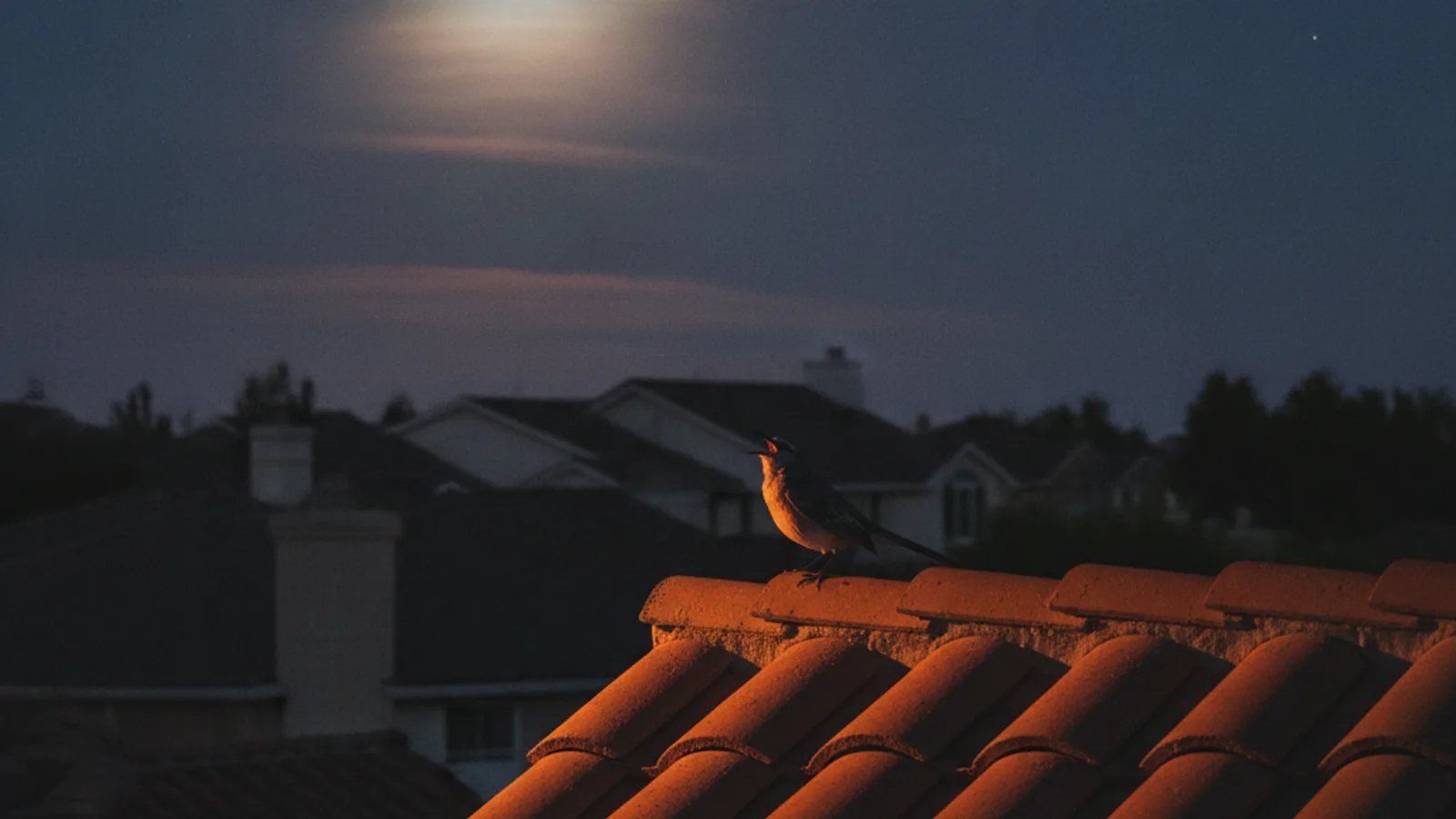
It's midnight, the window is open, and a bird outside is singing its heart out. Who is it, and why isn't it asleep? Night song is one of the most common bird questions people ever ask, and the good news is that the list of suspects is short. In most North American neighborhoods, nine species account for nearly every bird sound you'll hear after dark.
Here's the fast answer, then the details on each singer.
| What you hear | Most likely bird | When |
|---|---|---|
| Long, varied, non-stop performance, phrases repeated 3–6 times, then a new one | Northern Mockingbird | Spring–summer, all night |
| "Who cooks for you? Who cooks for you-all?" | Barred Owl | Year-round, peak winter–spring |
| Five deep, resonant hoots | Great Horned Owl | Peak Dec–Feb |
| Eerie descending whinny, like a tiny ghost horse | Eastern Screech-Owl | Year-round |
| "whip-poor-WILL!" repeated hypnotically | Eastern Whip-poor-will | Summer nights, rural woods |
| Cheerful robin song… at 3am under a streetlight | American Robin | Spring–summer, lit areas |
| Piercing "kill-DEER! kill-DEER!" flying overhead | Killdeer | Spring–fall, open areas |
| Nasal "peent!" high overhead at dusk | Common Nighthawk | Summer evenings |
| Soft short chips passing overhead, many voices | Migrating songbirds | Spring & fall nights |
The #1 Answer: Northern Mockingbird
If a bird is singing continuously outside your window at 1am, and the song keeps changing, it is almost certainly a Northern Mockingbird. Unmated males sing through the night in spring and early summer, and they are spectacular mimics: one bird may cycle through imitations of cardinals, jays, titmice, car alarms, and squeaky gates, repeating each phrase several times before switching. Full moons and bright streetlights make night singing even more likely. It stops once he finds a mate, so the all-night concert usually ends by midsummer.
Range note: Mockingbirds are common across the southern two-thirds of the US year-round and continue expanding north.
The Owls
The most-heard owl east of the Rockies. Eight hoots in two groups of four, the second phrase trailing off with a drawled "you-awwwll." Pairs often duet, and courting birds descend into a chaos of hoots, cackles, and monkey-like caterwauling that has convinced more than one camper something supernatural was in the woods. Most vocal late winter through spring, in moist woodland, but you can hear one any month of the year.
The deep, classic hoot of movies and Halloween. Great Horned Owls are midwinter birds at their vocal peak, December through February, while they establish territories and nest earlier than almost any other bird. Pairs duet, the female's hoots noticeably higher-pitched than the male's despite her larger size. Found in nearly every habitat on the continent, including city parks and suburbs with mature trees.
The screech-owl's name is misleading: it doesn't screech, and it doesn't hoot either. Its two main calls are a haunting whinny that slides downward like a miniature ghost-horse, and a soft, even trill (the "bounce song") used between mates. It's a small owl of suburbs, parks, and wood edges, far more common than most people realize, because the calls are quiet and easily missed. If you hear a soft, eerie trill from a big backyard tree, this is your bird. (Out west, the Western Screech-Owl gives an accelerating series of short toots, the "bouncing ball.")
The Summer Night Specialists
In rural eastern woodland on warm summer nights, the whip-poor-will chants its name in a rapid, hypnotic loop, one patient observer counted over 1,000 repetitions without a pause. They call most in the hours after sunset and before dawn, and most intensely on moonlit nights. In the Deep South, its larger cousin the Chuck-will's-widow sings a similar but lower, four-syllable version. Both have declined sharply, so hearing one is increasingly special, savor it.
That electric, slightly alien "peent" over ballfields, parking lots, and city rooftops on summer evenings is a nighthawk hawking insects around the lights. During courtship dives, air rushing through the male's wing feathers makes a sudden hollow whoom, like someone blowing across a giant bottle. Listen for them from late May through early September; September evenings can bring loose migrating flocks drifting south.
The Surprises
Robins are dawn-chorus birds, but artificial light scrambles their clocks. In brightly lit neighborhoods, robins routinely begin "dawn" song at 2–4am, and city robins sing earlier and longer than rural ones. If the cheerful, rolling song outside your window sounds like daytime robin song, because it is, blame the streetlight, not your ears. Full guide: American Robin complete guide.
Killdeer are semi-nocturnal and vocal about it. That shrill two-note cry sweeping across a parking lot, ballfield, or gravel lot at night, sometimes clearly moving overhead, is a killdeer, either commuting between feeding areas or reacting to a disturbance near its ground nest. They call year-round across most of the US and are one of the most common "mystery night screamer" solutions.
On calm spring and fall nights, most songbirds migrate in the dark, and they call constantly to stay in contact, short chips, buzzes, and whistles raining down from a few hundred feet up. A quiet night in late April or September can carry hundreds of calls per hour. It's one of birding's best-kept secrets: step outside around midnight during migration, look up, and listen. Our Migration Map 2026 shows when the waves pass through your region, and the fall migration guide covers the season in depth.
Night Sounds That Aren't Birds
Half of "what bird is that?" night mysteries aren't birds at all. Before you lose sleep over an unidentifiable singer, rule these out:
- Spring peepers and other frogs, a chorus of high, repeated whistles from wet areas in early spring is almost always frogs. A single peeper can sound remarkably bird-like.
- Crickets and katydids, the steady rhythmic "ch-ch-ch, ch-ch-ch" of late-summer nights is katydids; the even trill from the grass is crickets. Insect sound dominates August–September nights.
- Red fox, a raspy, unearthly scream that convinces people something is being murdered. It's a fox, and it's fine.
- Raccoons, chittering, growling, and squabbling from trees or roofs, especially where food is involved.
Why Do Birds Sing at Night?
Four main reasons cover nearly every case. Advertisement: unmated male mockingbirds (and occasionally other species) escalate to night song to reach females that daytime noise would drown out. Nocturnal lifestyles: owls, whip-poor-wills, and nighthawks simply live and communicate in the dark. Light pollution: streetlights trigger dawn-chorus behavior in robins and mockingbirds hours early, studies consistently show urban birds start singing earlier than rural ones. Migration: most songbirds travel at night and call to maintain flock contact, producing the overhead chip-notes of spring and fall.
Night song is not a bird in distress, it's biology working as designed, occasionally colliding with a streetlight.
Keep Going
Once you've named your night singer, the daytime chorus is next: our guide to identifying birds by song covers 20+ common species with mnemonics, and the backyard birds for beginners guide covers who you're hearing at the feeder. For every species mentioned here, the species library has photos, range maps, and full profiles.