Hummingbird Food Recipe: The Only Nectar Ratio You Need (4:1)
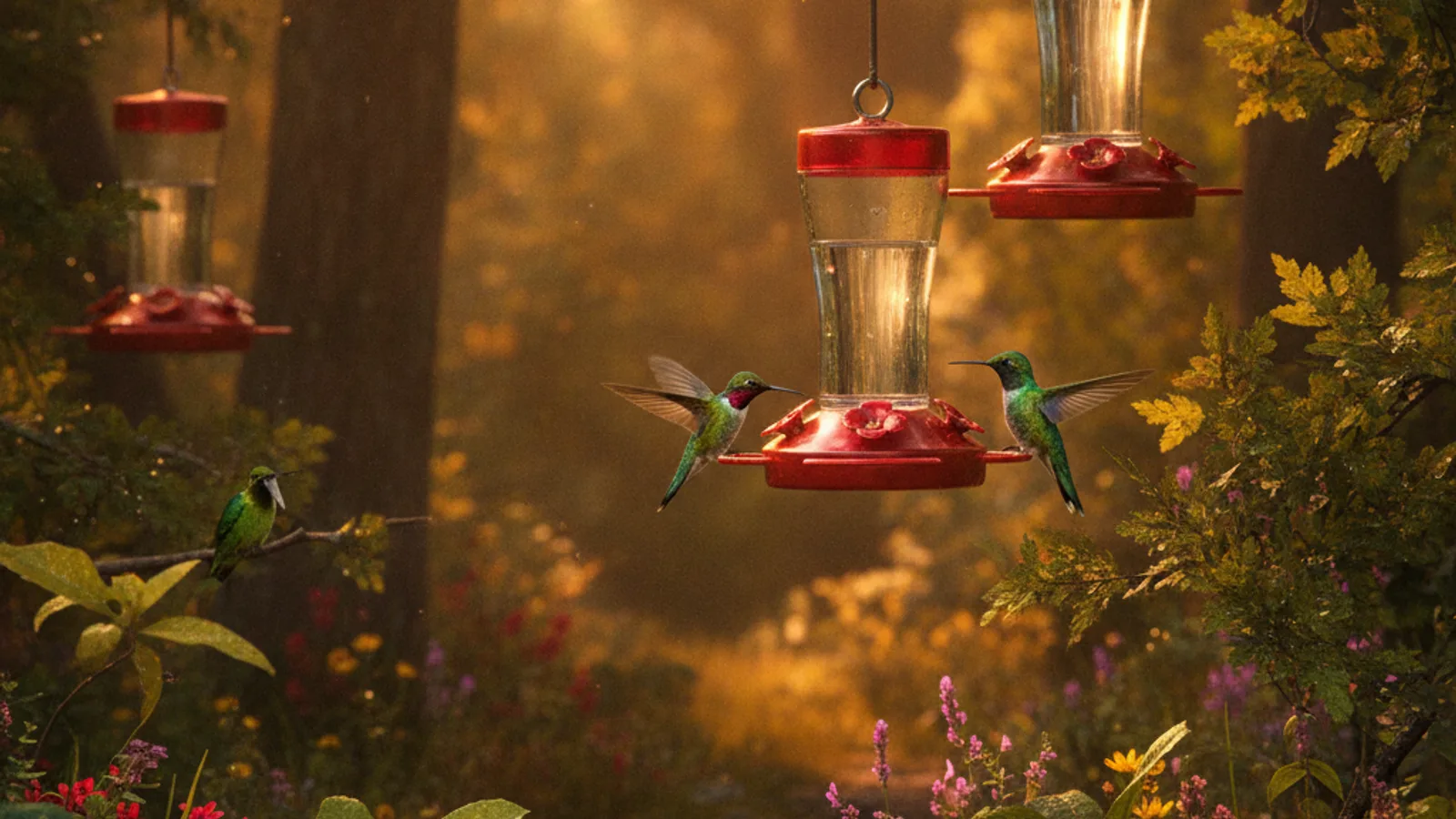
The entire recipe for homemade hummingbird food fits in one sentence: mix 4 parts water with 1 part plain white cane sugar until the sugar dissolves. That's it. No dye, no honey, no "nectar concentrate," no special ingredients. This 4:1 ratio closely matches the sugar concentration of the flower nectar hummingbirds evolved to feed on, and it's the mix recommended by every major ornithology and bird conservation organization.
So why is this a full article instead of a sentence? Because almost everything that goes wrong with hummingbird feeders happens after the mixing: nectar that turns cloudy in two days, feeders that grow black mold in the ports, well-meaning additions like honey or red dye that actively harm birds, and feeders taken down too early in fall while migrants still need fuel. This guide covers the recipe, a batch chart from 1 cup up to a full gallon, the replacement schedule that keeps nectar safe, and the handful of myths worth putting to rest.
The Homemade Hummingbird Food Recipe (Step by Step)
- Measure 4 parts water to 1 part white sugar. The classic starter batch is 1 cup of water and 1/4 cup of sugar, which fills most small feeders once.
- Heat the water. Bring it to a boil, or just run your tap as hot as it goes. Boiling is optional (more on that below); the only requirement is that the sugar dissolves completely.
- Stir in the sugar until the liquid turns fully clear with no grains at the bottom.
- Cool to room temperature. Hot nectar can damage feeder plastics and will spoil faster. Never hang a warm feeder.
- Fill the feeder only as full as the birds will drink in 2-3 days. A feeder that's half empty on schedule beats a full one growing yeast.
- Refrigerate the rest in a sealed jar or bottle. It keeps up to 2 weeks in the fridge.
Use plain white granulated cane sugar (regular table sugar). Sucrose is exactly what flower nectar contains, and refined white sugar is essentially pure sucrose. Beet sugar labeled as plain granulated sugar is also fine. Everything else on the sugar shelf is a problem, which we'll get to shortly.
Hummingbird Food Mixture at Home: The Batch Chart
Whatever your feeder size, keep the ratio at 4:1. Here's the chart from a single-feeder batch up to a full gallon:
| Water | White Sugar | Good For |
|---|---|---|
| 1 cup | 1/4 cup | One small feeder, one fill |
| 2 cups | 1/2 cup | One standard feeder, one fill |
| 3 cups | 3/4 cup | Two small feeders |
| 4 cups (1 quart) | 1 cup | Multiple feeders, or one fill + fridge extra |
| 16 cups (1 gallon) | 4 cups | Multi-feeder yards, peak season |
Hummingbird food recipe for 1 gallon
The 1-gallon batch is worth calling out because it's what people search for at peak season, and it's easy to get the math wrong when scaling up. One gallon is 16 cups of water, so at 4:1 you need exactly 4 cups of sugar. Dissolve the sugar in a few cups of boiled or very hot water first, then top up with cool water to reach a gallon; you'll get to feeder-safe temperature much faster than cooling a full gallon of hot liquid. Store it in a sealed pitcher or clean jug in the fridge and it will stay fresh for up to 2 weeks, which comfortably covers a week of refills across several feeders.
Do You Need to Boil the Water?
No. This is the most common point of confusion, so here's the honest breakdown. Boiling does two useful things: it dissolves sugar almost instantly, and it kills any yeast or mold spores already in the water or sugar, which can help the mix keep slightly longer before fermenting. That's a real but small benefit.
Here's why it's small: the moment the first hummingbird feeds, its tongue introduces microbes into the nectar. From that point on, your feeder is a warm sugar solution being inoculated all day long, and no amount of boiling at mixing time changes that. Replacement frequency is what keeps nectar safe, not sterilization. If boiling fits your routine, do it. If hot tap water dissolves your sugar, that's genuinely fine too. What matters is a fully dissolved 4:1 mix and a feeder that gets emptied, cleaned, and refilled on schedule.
What NEVER Goes in Hummingbird Food
The list of things people add to nectar with good intentions is long, and every item on it ranges from pointless to dangerous:
- Red dye. Completely unnecessary and potentially harmful. Hummingbirds find feeders by the red plastic parts on the feeder itself, not by red liquid. A hummingbird drinks several times its body weight in nectar daily, which means dyed nectar delivers a concentrated dose of dye to a bird weighing about as much as a nickel. There is zero upside. Skip it, and skip the pre-dyed commercial "nectar" too; you're paying a premium for sugar water plus a risk.
- Honey. Honey ferments rapidly when diluted and can grow a fungus dangerous to hummingbirds. It is not "more natural" for a hummingbird. Flower nectar is sucrose; honey is chemically different and spoils into something genuinely hazardous.
- Brown sugar, raw sugar, turbinado, or molasses. These contain iron, and hummingbirds are unusually sensitive to iron; even small amounts can be harmful over time. White refined sugar has the iron removed. This is one case where the less-processed option is the worse one.
- Artificial sweeteners. A hummingbird burns calories faster than almost any animal on Earth and feeds specifically for those calories. Zero-calorie nectar is effectively starving birds while making them feel like they've fed.
- Powdered or confectioner's sugar. It contains anti-caking additives (usually cornstarch) that cloud the mix and speed spoilage. Granulated only.
Hummingbird Food Gets Cloudy? That's Fermentation. Replace It.
Cloudy nectar is the single most searched hummingbird feeder problem, and the answer is simple: cloudiness means the sugar water is fermenting. Yeast and bacteria are multiplying in it, and it needs to be dumped now, not topped off, not stirred, not left "one more day." Fermented nectar can harm hummingbirds, and birds will often abandon a feeder with spoiled nectar entirely, which reads to the frustrated owner as "the hummingbirds disappeared."
The fix is a schedule, not a product:
- Above 80 F: replace nectar every 2-3 days, even if the feeder is still mostly full.
- Mild weather (60s-70s F): every 4-5 days.
- Any weather: immediately if the nectar looks cloudy, has black specks, smells sour, or you can see mold in the ports.
Two placement tricks stretch these windows to their maximum. First, hang the feeder in shade; direct sun cooks sugar water and can push spoilage to under 48 hours in summer heat. Second, fill the feeder only partway. A feeder that holds 16 ounces but hosts two hummingbirds will never be drunk down in 3 days, so most of that nectar exists only to spoil. Small fills, changed often, wins every time.
How to clean a hummingbird feeder
Every time you change the nectar, rinse the feeder with hot water. Once or twice a week, do a real cleaning: hot water and white vinegar (roughly one part vinegar to two parts water), a bottle brush for the reservoir, and a small port brush or pipe cleaner for the feeding ports where black mold starts. Rinse thoroughly. Avoid dish soap if you can; soap residue clings to plastic and birds can taste it, and a soapy film is harder to fully rinse out of narrow ports than vinegar. If a feeder has visible mold you can't reach, soak it disassembled in the vinegar solution before scrubbing. Feeders that fully disassemble are dramatically easier to keep clean, which is worth remembering when you buy your next one (our hummingbird feeder guide covers what to look for).
Where to Hang the Feeder
- Shade, at least in the afternoon. Shade is the difference between nectar lasting 3 days and spoiling in 1. Morning sun is fine; afternoon summer sun is the spoilage engine.
- Out of cat reach. Five feet or more off the ground, and at least a few feet from shrubs or railings a cat could launch from. Hummingbirds hover with their backs to the world while feeding; they're at their most vulnerable at a feeder.
- Near cover, not buried in it. Hummingbirds like a nearby perch (a thin branch or wire) to guard "their" feeder from. A feeder within 10-15 feet of a tree or large shrub gets adopted faster.
- Where you can see it. Feeders you watch get cleaned on time. Feeders around the side of the house grow mold quietly.
- Apart from other feeders. Hummingbirds, especially the Ruby-throated Hummingbird that dominates eastern North America, are ferociously territorial. If one bird is chasing all the others away, the fix is a second feeder out of sight of the first, not a bigger feeder.
When to Put Feeders Up and Take Them Down
Timing depends on where you live, but the principle is the same everywhere: be early in spring and late in fall.
- Gulf Coast and Deep South: feeders up by late February; some hummingbirds overwinter here, so year-round feeding is reasonable.
- Mid-Atlantic, Midwest, and mid-country: up by late March to mid-April, ahead of the first Ruby-throated arrivals.
- Northern US and southern Canada: up by late April to early May.
- Pacific Coast: Anna's Hummingbirds are resident year-round in much of the West Coast; feeders can stay up all year.
In fall, do not take your feeder down early. The persistent myth that a feeder will "stop hummingbirds from migrating" is exactly backwards. Migration is triggered by day length and hormonal changes, not by food availability; a hummingbird will leave on schedule no matter how good your feeder is. What a late-season feeder actually does is refuel birds that are already migrating through, which is when they need calories most. The standard rule: leave the feeder up until two weeks after you've seen your last hummingbird. In the northern US that usually means late September into October; further south, later still. Late stragglers and off-course western vagrants sometimes turn up at the only feeder left on the block, so being the last feeder standing occasionally rewards you with a rare bird. For the bigger picture on timing, see our fall migration guide.
Quick Troubleshooting
- No hummingbirds at a new feeder: give it 1-2 weeks, make sure the feeder has red parts, and keep the nectar fresh the whole time. A bird that finds spoiled nectar on visit one may not return.
- Birds came, then stopped: check the nectar first (cloudy? moldy ports?). Also normal in midsummer when natural flowers peak, and in early fall when locals depart before migrants arrive.
- Ants in the feeder: use a small water-filled ant moat above the feeder. Never put oil or petroleum jelly on the hanger; it can transfer to feathers.
- Bees and wasps swarming ports: choose saucer-style feeders where nectar sits below the port reach of insects, and skip any yellow "bee guard" accents, which attract them.
- Not sure what species you're seeing? Start with the Ruby-throated Hummingbird profile if you're east of the Great Plains, where it's the only breeding hummingbird, or browse species to compare.
Frequently Asked Questions
What is the ratio of sugar to water for hummingbird food?
4 parts water to 1 part plain white cane sugar: 1 cup water with 1/4 cup sugar, or 4 cups water with 1 cup sugar. Stir until dissolved, cool, and fill the feeder. The 4:1 ratio closely matches natural flower nectar.
Do you have to boil water for hummingbird food?
No. Boiling dissolves sugar fast and helps the batch keep slightly longer, but very hot tap water works as long as the sugar fully dissolves. The nectar gets contaminated the moment a bird feeds anyway, so the replacement schedule matters far more than boiling.
How do you make 1 gallon of hummingbird food?
Mix 16 cups (1 gallon) of water with 4 cups of white sugar, the same 4:1 ratio. Dissolve, cool, fill your feeders, and refrigerate the rest in a sealed container for up to 2 weeks.
Why does my hummingbird food get cloudy?
Cloudy nectar is fermenting. Dump it immediately, clean the feeder with hot water and vinegar, and refill fresh. Prevent it by replacing nectar every 2-3 days above 80 F, every 4-5 days in milder weather, and by hanging the feeder in shade.
Is red dye bad for hummingbirds?
Red dye is unnecessary and potentially harmful, so leave it out. The red parts of the feeder attract the birds; the nectar itself should be clear. Plain 4:1 sugar water is what every major bird organization recommends.
When should you take hummingbird feeders down in the fall?
Leave them up until two weeks after your last hummingbird sighting. Feeders do not delay migration; that's a myth. Migration is triggered by day length, and a late feeder helps migrating birds refuel when they need it most.
Fresh 4:1 nectar in a clean feeder is the whole game. Get the schedule right and the birds handle the rest. For the setup around the recipe, see our picks for the best hummingbird feeders, read up on the Ruby-throated Hummingbird, and check the fall migration guide so you know when your local birds arrive and leave.