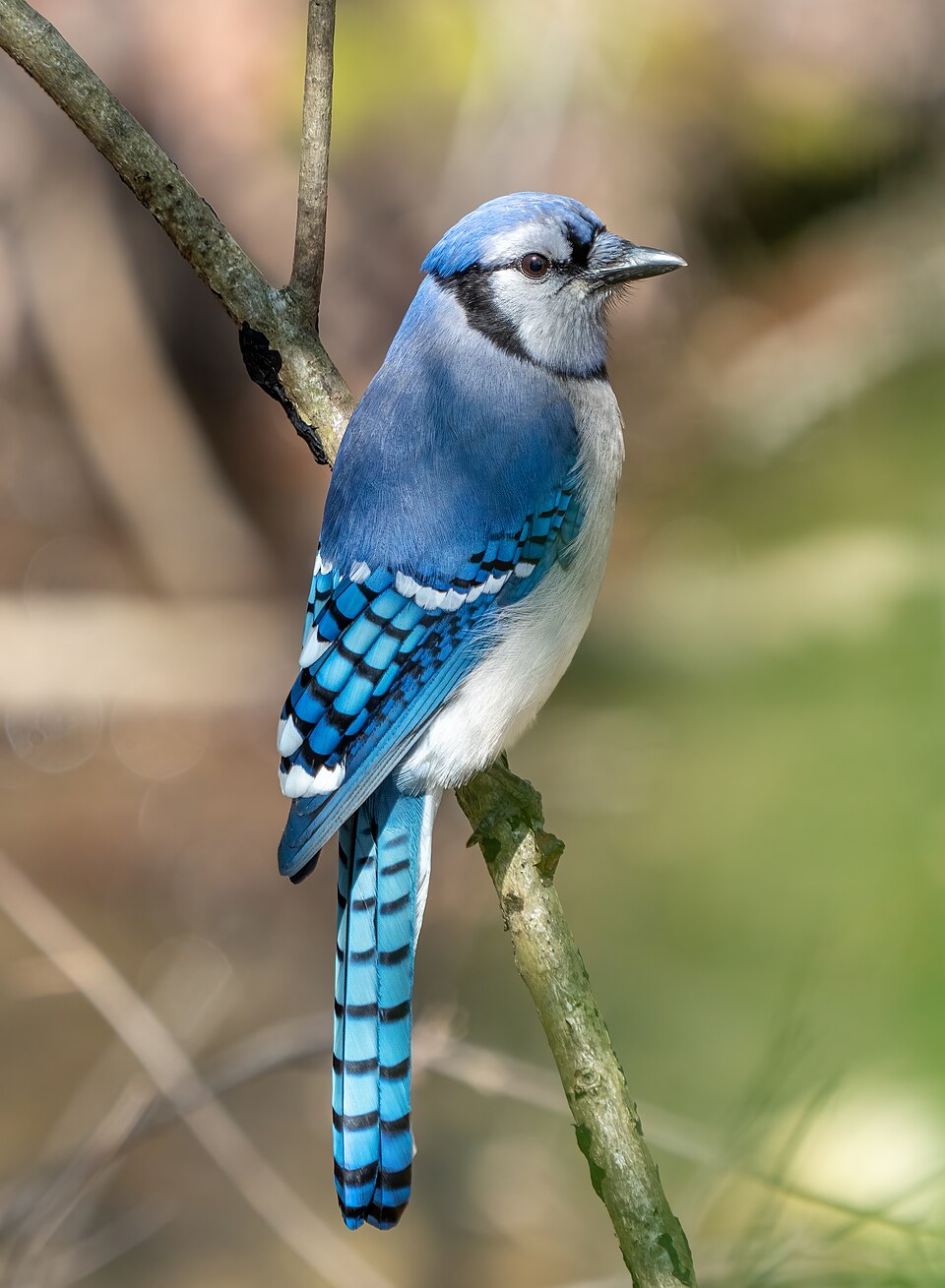
Few backyard birds make an entrance like the Blue Jay. Loud, brash, and unmistakably blue, it sweeps into the feeder, scatters the smaller birds, grabs a beakful of peanuts, and is gone again in seconds. For many people in the eastern United States and Canada, this is the bird that taught them that birds have personalities. Behind the swagger is a genuinely brilliant animal, a member of the corvid family, alongside crows and ravens, with the problem-solving smarts to match.
Blue Jays are creatures of woodland edges, parks, and leafy neighborhoods, anywhere oaks and beeches drop a reliable crop of nuts. They are famous acorn hoarders, caching thousands of nuts each fall and, in the process, planting countless oak trees they never come back for. They are also accomplished mimics, capable of imitating the scream of a Red-shouldered Hawk so convincingly that they clear a feeder of competitors. Bold, beautiful, and endlessly watchable, the Blue Jay rewards anyone willing to pay attention.
The Blue Jay is a large, crested songbird, bigger than a robin, with a stout build, a long tail, and a pointed crest it raises and lowers with its mood. Its blue, white, and black pattern is striking and, once learned, hard to confuse with anything else in its range.
| Crest | Prominent pointed blue crest on the head, raised when alarmed or excited and flattened when relaxed or submissive. |
| Upperparts | Bright blue back, wings, and tail. The wings and tail are barred with black and marked with bold white patches. |
| Underparts | Pale gray to whitish breast and belly, giving a clean, light-bellied look in flight. |
| Face & collar | A black necklace curves up around the throat and across the chest, framing a whitish face. |
| Bill & eyes | Heavy, straight black bill and dark eyes, a sturdy, all-purpose tool for cracking nuts and seizing food. |
| Tail | Long and rounded, blue above with black bands and white tips on the outer feathers, obvious as it flies away. |
Male vs. female
Male and female Blue Jays look essentially identical, same blue plumage, same crest, same black necklace, so you cannot reliably tell them apart by sight in the field. Males average slightly larger, but the difference is too small to judge on a single bird. Behavior offers the best clue during breeding season: the female does the incubating and is often fed by the male, who brings food to her on the nest in a courtship ritual.
Juveniles
Recently fledged Blue Jays look much like adults but softer and grayer overall, with a fluffier, less crisply patterned plumage and a shorter crest. Their colors are duller, the black necklace is fainter, and they often show a slightly grayish cast to the body. Young birds beg loudly and follow their parents around for weeks after leaving the nest, so in midsummer you may see a clumsy, vocal jay shadowing a more polished adult.
The Blue Jay's signature sound is a loud, harsh jeer or jay-jay-jay, ringing and slightly nasal, often given when the bird spots a predator or simply wants the whole yard to know it has arrived. It is one of the most familiar voices of eastern woodlands. They also produce a remarkable musical note that sounds like a rusty gate or a squeaky pump handle, a clear tull-ull or queedle-queedle that surprises people who only know the screaming call.
Blue Jays are skilled mimics, and they imitate hawks especially well. The piercing kee-aah scream of a Red-shouldered Hawk, copied note-for-note by a jay, can send other birds diving for cover, which may be exactly the point when a feeder is crowded. Around the nest and among family groups they switch to soft, almost conversational clicks, whistles, and whirring notes that are easy to miss unless you are close.
Blue Jays live across the eastern and central United States and southern Canada, from the Atlantic coast west to the Great Plains, and their range has been creeping westward as people plant trees and stock feeders. They are year-round residents through most of this area, and many individuals never migrate at all.
Migration in this species is famously puzzling. Each fall, large loose flocks of Blue Jays stream along the Great Lakes shorelines and Atlantic coast in daytime movements that birders gather to watch, yet plenty of jays in the same region stay put all winter. A bird that migrates one year may not the next, and biologists still do not fully understand what triggers the decision, food supply and a bird's age both seem to play a role.
Blue Jays are omnivores with a strong preference for nuts and seeds. Acorns and beechnuts are dietary staples, and in autumn a single jay may haul off and bury hundreds or even thousands of acorns, carrying several at a time in an expandable throat pouch. Much of this stash is never recovered, which makes the Blue Jay one of the most important natural planters of oak forests in North America. They also relish corn, peanuts, and sunflower seeds, along with fruit, insects like beetles and caterpillars, and the occasional small vertebrate.
At feeders, jays are bold and efficient. They tend to fly in, load up, and leave rather than lingering, and a peanut feeder will draw them like nothing else. They sometimes get a bad reputation for raiding other birds' nests for eggs or nestlings, but studies show this is a small part of their diet, far less than their loud, conspicuous behavior might lead you to assume.
Blue Jays build an open cup nest of twigs, bark, moss, and rootlets, usually wedged in the crook of a tree or in a dense shrub anywhere from about 10 to 25 feet up. Both members of the pair gather material and work on construction, though the female does most of the actual building. They are notably secretive around the nest, falling quiet and slipping in and out without the usual noise, a striking contrast to their otherwise rowdy nature.
The female lays a clutch of eggs that are bluish or buff with brownish spotting, and she does most of the incubating while the male brings her food. Once the young hatch, both parents feed them. After fledging, the family stays together for a month or two, with the young birds begging and trailing their parents as they learn to forage.
Blue Jays are very much a backyard bird, and they are one of the easiest larger species to draw in if you offer the right food. They prefer to feed from sturdy platforms or hopper feeders rather than small clinging perches, and they have a particular weakness for peanuts.
- Offer whole peanuts in the shell on a platform feeder or scattered on a railing, jays love them and will visit repeatedly to cache them.
- Provide a sturdy platform or hopper feeder with sunflower seeds and cracked corn; flimsy tube feeders are too small for their size.
- Plant or keep oak, beech, and other nut-bearing trees, which supply the acorns and beechnuts at the heart of their natural diet.
- Add a birdbath, jays drink and bathe readily, and moving or dripping water is especially attractive.
- Accept their boisterous behavior; jays will dominate a feeder briefly, but they often act as an early-warning system that alerts other birds to hawks and cats.
- Avoid worrying about them scaring off smaller birds, the jays come and go quickly, and the feeder usually refills with chickadees and finches between visits.
- Steller's Jay: The western counterpart, with a charcoal-black head and crest blending into deep blue body, much darker overall and found in western mountain and coastal forests where Blue Jays are scarce.
- Florida Scrub-Jay: Blue and gray but crestless, with a pale grayish back and no black necklace; restricted to Florida scrub habitat rather than woodlands and feeders.
- Belted Kingfisher: Also blue-gray and crested, but stockier with a huge dagger bill, a white collar, and a habit of perching over water and diving for fish, not a songbird.
- Eastern Bluebird: Much smaller and crestless, with a rusty-orange breast and no black-and-white patterning; a gentle open-country bird rather than a bold feeder raider.
Are Blue Jays mean or aggressive to other birds?
Blue Jays can be dominant at feeders and will briefly chase smaller birds away, but they are not as villainous as their reputation suggests. They usually grab food and leave quickly, and nest-raiding is a minor part of their diet. They also alert the whole yard to hawks and cats, which benefits other species.
Why do Blue Jays sound like hawks?
Blue Jays are talented mimics and often imitate the scream of a Red-shouldered Hawk. They may do this to test whether a real hawk is nearby, or to scatter competitors from a food source so they can feed undisturbed. It is a normal, clever part of their behavior.
What is the best food to attract Blue Jays?
Whole peanuts in the shell are the single best draw, offered on a platform feeder or simply scattered on a deck railing. Blue Jays also love sunflower seeds, cracked corn, and suet, and they need a sturdy feeder rather than a small tube feeder to perch comfortably.
Do Blue Jays migrate?
Some do and some don't, even within the same area. Large flocks migrate along the Great Lakes and Atlantic coast each fall, yet many jays stay year-round. An individual bird may migrate one year and remain the next, and scientists still don't fully understand why.
Why don't I see Blue Jays in the western United States?
Blue Jays are primarily birds of the eastern and central part of the continent, though their range is slowly expanding westward. In the West you're more likely to find the closely related Steller's Jay, which has a dark head and crest, in mountain and coastal forests.