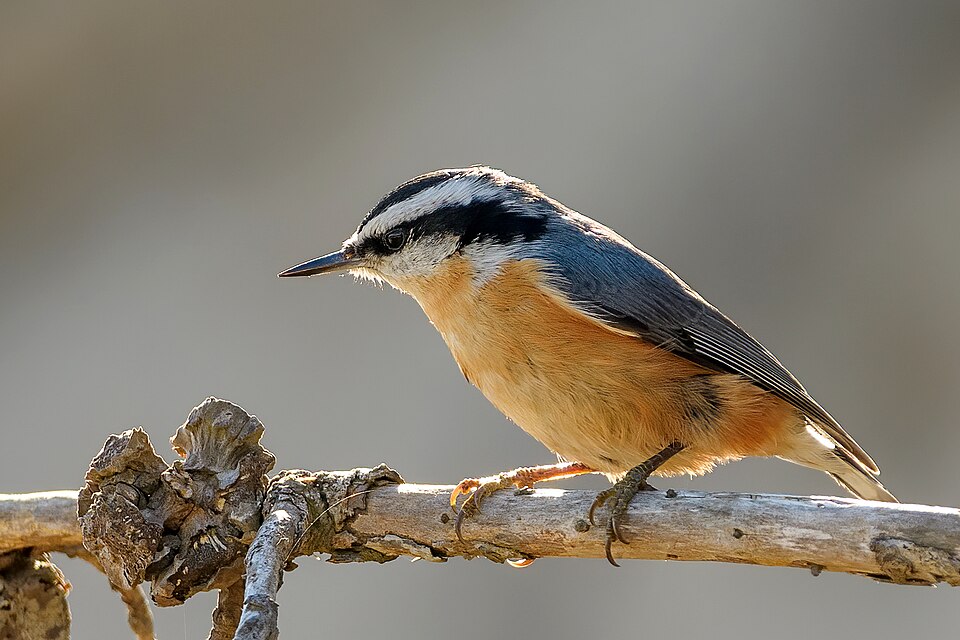
The Red-breasted Nuthatch is a compact, energetic little bird that seems to defy gravity, scooting headfirst down tree trunks and hanging upside down from cone-laden branches as it hunts. Smaller and more delicately built than its cousin the White-breasted Nuthatch, it carries a bold black-and-white striped face and a wash of warm rusty color across its underparts. It is a true bird of the conifers, most at home among spruce, fir, pine, and hemlock across the boreal forests of Canada and the mountain woodlands of the western and northeastern United States.
What makes this species especially fun to follow is its voice and its wandering habits. Its nasal little yank-yank call sounds like a toy tin horn and often gives the bird away long before you spot it. And in years when the northern cone crop fails, Red-breasted Nuthatches stage dramatic "irruptions," pouring far south of their usual haunts and showing up at backyard feeders in places that may not see them again for years. For many birders, a Red-breasted Nuthatch at the suet feeder is the happy surprise that signals an irruption winter has arrived.
This is a tiny, stub-tailed songbird with a large head, almost no neck, and a long, slightly upturned bill. The short tail and compact, front-heavy shape give it a distinctive look as it creeps along trunks and branches, frequently moving head-down in a way few other birds can manage.
| Size | Very small, about 4.5 in long - noticeably smaller and slimmer than a White-breasted Nuthatch and about chickadee-sized but with a stubbier tail. |
| Face pattern | Bold black cap and a black line through the eye, separated by a clean white eyebrow stripe. This striped face is the key field mark. |
| Underparts | Washed with warm rusty-cinnamon, from peachy to deep brick-red depending on the bird and sex. |
| Upperparts | Blue-gray back and wings, smooth and unmarked. |
| Bill | Long, thin, sharply pointed and slightly upturned - a chisel for prying into bark and cones. |
| Tail | Short and square, with white corners visible in flight or when fanned. |
Male vs. female
The sexes look similar but can usually be told apart with a good view. Males have a jet-black cap and crisp black eye-line, with deeper, more saturated rusty-red underparts. Females are a touch more muted: the cap is duller and more slate-gray than true black, and the underparts are paler, often a soft buffy-peach rather than rich brick-red. In poor light or brief looks the two can be hard to separate, but a side-by-side pair makes the difference clear.
Juveniles
Juveniles look much like adults by the time they leave the nest, sharing the striped face and rusty wash, but they are slightly duller and fresher-plumaged overall. Young males resemble adult males and young females resemble adult females, so the same cap-color and underpart-saturation clues apply, just less crisply. By their first winter they are essentially indistinguishable from adults in the field.
The signature call is an unmistakable nasal yank-yank-yank or ank-ank, often likened to a tiny tin horn or a toy trumpet. It is higher, thinner, and faster than the lower, more drawling call of the White-breasted Nuthatch, and birders quickly learn to pick it out. The bird often repeats the note steadily as it forages, so a series of nasal little toots drifting down from the conifers is a reliable clue.
Beyond the familiar yank, Red-breasted Nuthatches give a soft, rapid chatter and various conversational notes between mates. The "song," delivered in the breeding season, is a fast series of these nasal notes run together into a hurried, slightly laughing trill.
Red-breasted Nuthatches breed across the vast boreal forest belt of Canada and Alaska and southward through the conifer-rich mountains of the western United States - the Rockies, the Cascades, the Sierra Nevada - as well as the northern hardwood-conifer forests of the Great Lakes, New England, and the Appalachians. Wherever there is healthy spruce, fir, pine, or hemlock, they are likely present.
Movement is the interesting part. Many northern birds are partial migrants, and the species is famous for its irruptions: in autumns following a poor cone crop in the north, large numbers move well south of the breeding range, reaching the southern United States and occasionally the Gulf Coast and northern Mexico. In a good cone year they may barely budge. This boom-and-bust wandering means a backyard far south of the breeding range may host them one winter and not see them again for several.
In the breeding season Red-breasted Nuthatches are mainly insectivores, gleaning beetles, caterpillars, spiders, and other small arthropods from bark crevices and conifer needles. They forage acrobatically, working trunks and branches in every orientation, and like other nuthatches they wedge larger food items into bark and hammer them open with the bill - the behavior that gives the family its name ("nut-hatchers").
In fall and winter the diet shifts heavily to conifer seeds pried from spruce, fir, and pine cones, which is exactly why their movements track the cone crop so closely. They readily cache food, jamming seeds and insects into bark cracks for later. At feeders they take sunflower seeds (especially hulled or black-oil), suet, and peanuts, often grabbing a single seed and darting off to wedge and hack it open or hide it.
Red-breasted Nuthatches are cavity nesters, and unlike most cavity users they typically excavate their own hole in soft, rotten wood of a dead tree or branch, though they will also use old woodpecker holes and nest boxes. Both members of the pair help dig. The female builds the inner cup from grass, bark fibers, and soft plant material.
Their most distinctive habit is smearing sticky conifer resin around the entrance hole, carrying it in their bills or on bits of bark and applying it to the rim. The sticky barrier is thought to deter predators and competitors from entering, and the birds themselves dive straight through the opening to avoid getting stuck. The female incubates a clutch of pale, reddish-speckled eggs while the male brings her food, and both parents feed the nestlings.
Yes - this is a genuine feeder bird, though whether you get them depends heavily on your habitat and the cone crop to the north. If you live near or within conifer forest you have a good shot year-round; elsewhere, your best chances come during irruption winters. A few simple offerings improve your odds.
- Offer black-oil sunflower seeds (hulled hearts are taken eagerly) and suet, their two favorite feeder foods, plus shelled peanuts.
- Put up a nest box with a small (about 1.25 inch) entrance hole near conifers - they readily use boxes and will line the entrance with sticky resin.
- Keep conifers on your property if you can; spruce, fir, and pine provide both food and nesting habitat and are the single biggest draw.
- Watch for them especially in irruption years - if Red-breasted Nuthatches are being widely reported in fall, keep feeders stocked because southbound birds wander into new yards.
- Leave a few dead trees or snags standing where safe; soft, rotting wood gives them sites to excavate their own nest cavities.
- Provide a water source such as a birdbath; like most small birds they visit reliable, clean water.
- White-breasted Nuthatch: Larger, with clean white face and underparts and no black eye-line; lacks the rusty belly and gives a lower, more nasal call.
- Brown-headed Nuthatch: Southeastern pine specialist with a brown cap (not black) and no rusty underparts; gives squeaky, rubber-ducky calls.
- Pygmy Nuthatch: Western pine bird with a gray-brown cap, whitish underparts, and no bold black-and-white face stripes; very social, traveling in chattering flocks.
- Black-capped Chickadee: Similar size and a black cap, but has a black bib, white cheeks, a longer tail, and perches upright rather than creeping head-down on trunks.
What does a Red-breasted Nuthatch sound like?
Its trademark call is a nasal, high-pitched yank-yank that sounds like a tiny tin horn or toy trumpet, often repeated steadily as the bird forages. It is thinner and faster than the lower call of the White-breasted Nuthatch.
How do I tell a Red-breasted Nuthatch from a White-breasted Nuthatch?
The Red-breasted is smaller, has a black line through the eye and a white eyebrow stripe, and shows rusty-washed underparts. The White-breasted is larger with a clean white face and white underparts and no eye-line.
Why do Red-breasted Nuthatches suddenly show up some winters and not others?
They are an irruptive species. When the conifer cone crop fails in the northern forests, large numbers move far south to find food, appearing at feeders well outside their usual range. In good cone years they mostly stay put up north.
What do Red-breasted Nuthatches eat at feeders?
They favor black-oil sunflower seeds (including hulled hearts), suet, and peanuts. They typically grab one seed at a time and fly off to wedge it in bark and hammer it open, or to cache it for later.
Why do Red-breasted Nuthatches put sap around their nest hole?
They smear sticky conifer resin around the cavity entrance, probably to deter predators and competing birds. The nuthatches dive straight through the opening to avoid getting stuck in their own resin trap.