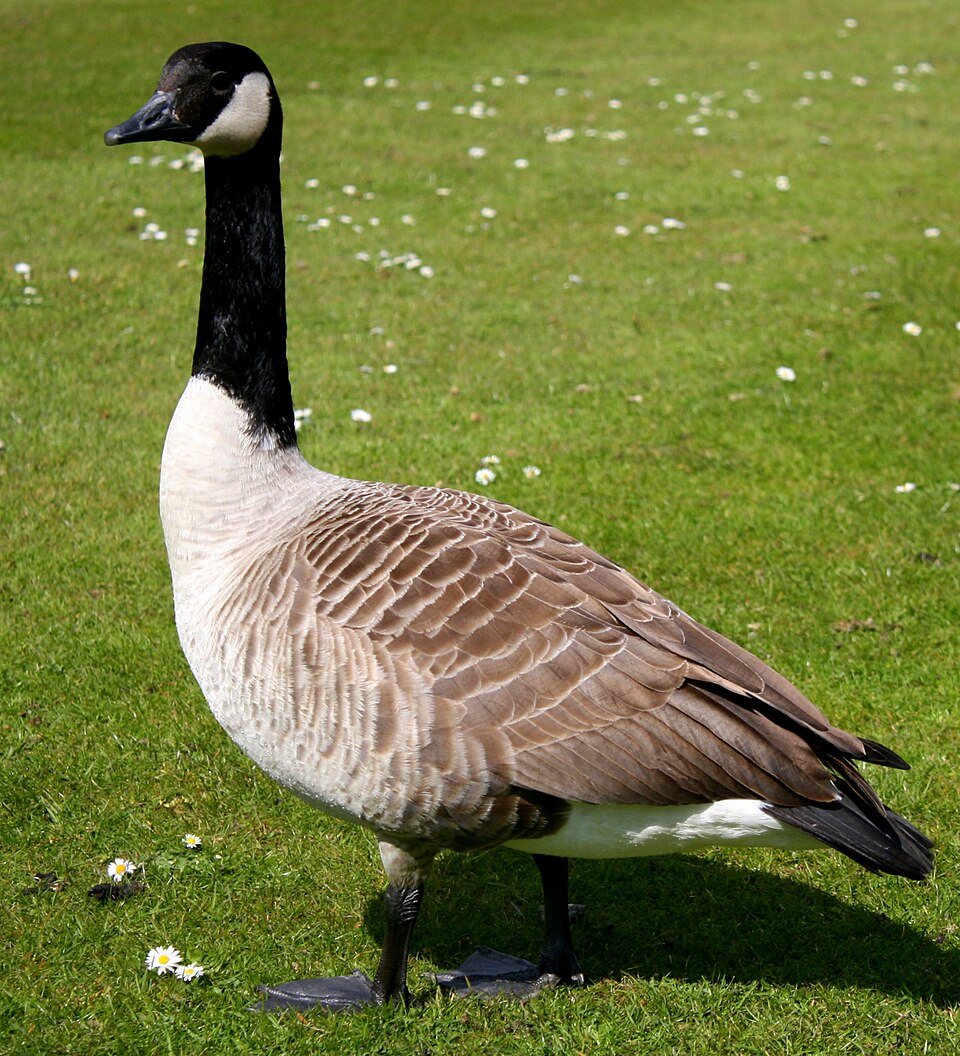
Few North American birds are as instantly recognizable as the Canada Goose. With its long black neck, white chinstrap, and brown body, it's the goose most people picture when they hear the word "goose" at all. Once a bird that prompted a rush to the window during spring and fall migration, it has become a year-round fixture of parks, golf courses, retention ponds, and suburban lawns across much of the continent. Its honking V-formations overhead remain one of the great sounds of the changing seasons, even as resident flocks now graze city greenspaces in every month of the year.
The species is remarkably variable in size, ranging from birds barely larger than a Mallard to hulking individuals weighing well over ten pounds. That variation reflects a tangle of subspecies that breed from the High Arctic to the temperate United States. Canada Geese are family-oriented, fiercely protective of their young, and quick to adapt to human-altered landscapes, a combination that has made them both beloved and, in many places, controversial. Whatever your feelings, they are endlessly watchable: devoted parents, strong fliers, and confident grazers that have figured out how to thrive right alongside us.
A large, long-necked, heavy-bodied waterfowl with a small head and a broad, rounded body. On the water it sits high and sturdy; in flight the long neck stretches straight out front and the broad wings beat in a slow, powerful rhythm. Size varies enormously by population, but the head-and-neck pattern is the giveaway and is identical across all of them.
| Head & neck | Jet-black neck and head with a bold white chinstrap that wraps from cheek to cheek under the throat |
| Body | Brownish-gray back and flanks, paler tan to creamy breast, contrasting cleanly with the black neck |
| Rear end | White U-shaped band across the base of the tail above a black tail, obvious in flight and when tipping up |
| Bill & legs | Black bill and black legs and feet |
| In flight | Long neck held straight out, broad dark wings, white rump band; flocks form ragged V or diagonal lines |
| Size range | Highly variable, from small Mallard-plus birds to massive 45-inch giants depending on subspecies |
Male vs. female
Males and females look alike, with identical plumage, the same black neck and white chinstrap, and no seasonal change in color. The main difference is size: the male (called a gander) averages noticeably larger and heavier-necked than the female (the goose), and within a mated pair this is often visible when the two stand side by side. Behavior helps too. The gander tends to take the aggressive, head-low, hissing role when defending a nest or goslings, while the female does most of the incubating. Outside of a bonded pair, telling the sexes apart in a mixed flock is essentially impossible by sight.
Juveniles
Goslings are downy yellow to olive-gray and follow their parents in a tidy line within a day of hatching, grazing almost immediately. By a few weeks old they take on a duller, fuzzier version of the adult pattern, and the black neck and white cheek patch fill in as they grow. Juveniles in their first summer and fall closely resemble adults but look slightly scruffier, with a less crisply defined chinstrap and somewhat duller, more mottled body feathers. Young birds stay with their family group through their first migration and often into the following spring, which is why you'll see geese traveling in tight family clusters within larger flocks.
The classic call is the loud, resonant two-note honk, often written as a-honk or ka-ronk, with the gander giving a lower-pitched note and the female a higher one. In flight, a moving flock keeps up a rolling chorus of honks that carries a remarkable distance and is, for many people, the very sound of migration.
Up close, Canada Geese have a surprisingly large vocabulary. Threatened or annoyed birds give a long, snake-like hisssss with the neck lowered and bill open, a clear warning to back off. Pairs and families exchange soft, conversational murmurs and grunts while grazing, and goslings give thin peeping contact calls. During courtship and greeting, mates perform a noisy "triumph" display, calling together with necks extended.
Canada Geese breed across nearly all of Canada and the northern and central United States, and they winter through most of the United States and into northern Mexico. Historically the species was a true long-distance migrant, with northern-breeding populations funneling south each fall along well-worn flyways and returning north in spring. Those migratory flocks still exist and still pour overhead in honking lines every spring and fall.
The bigger story of the last several decades is the explosion of non-migratory "resident" geese. Birds established or reintroduced in temperate areas often stay put year-round wherever open water, mowed grass, and mild winters let them, which is why golf courses and city ponds now host geese in July as readily as in January. The species has also been introduced and become established well outside its native range, including parts of Europe and New Zealand.
Canada Geese are primarily grazers, and their love of short, tender grass is exactly why they congregate on lawns, athletic fields, and golf courses. They clip grass, sedges, and clover with the serrated edges of the bill, and they readily eat agricultural waste grain such as corn, wheat, and rice, which is a major food source on migration and in winter. In wetlands they also feed on aquatic vegetation, roots, and tubers, sometimes tipping up like a dabbling duck to reach plants below the surface.
Feeding is mostly a daytime activity, with flocks often moving between a roosting body of water and nearby feeding fields or grassy areas. Goslings and breeding adults take more insects and other small invertebrates when available, providing the extra protein young birds need to grow quickly. The species' adaptable, grass-based diet is a key reason it does so well in human-modified landscapes.
Pairs form long-term bonds, often for life, and return to nest near where they bred before. The female builds the nest, typically a shallow bowl of grasses and plant material lined with soft down, placed on the ground near water on an island, a muskrat lodge, a shoreline, or increasingly on rooftops, planters, and other elevated human structures that feel safe from predators.
The female does all the incubating while the gander stands guard nearby, and both parents are famously aggressive in defense, lowering the head, hissing, and charging at intruders, including people and dogs, that come too close. Once the goslings hatch, the family leaves the nest within a day, and the parents lead the brood to water and protective cover. Adults undergo a flightless molt in summer, regrowing their flight feathers about the time the young are nearly ready to fly, so the whole family regains the air together.
Canada Geese are not a feeder bird, and in most situations the honest advice is the opposite of "attract": you generally don't want to encourage them, and intentionally feeding them does real harm. They visit yards for habitat (open water plus short grass) rather than for seed, and a flock can quickly overwhelm a small space with droppings and aggressive behavior, especially near a nest.
- Don't feed them bread or scraps. Handouts cause crowding, dependence, water pollution, and a crippling wing deformity called angel wing in goslings fed high-carb human food.
- To discourage geese, let lawn grass grow tall near water and plant dense shrubs or tall native plantings along shorelines, since geese avoid spots where they can't see approaching predators.
- If you want to watch them, visit a local park pond, reservoir, or wetland in spring to see goslings, or scan the sky during spring and fall migration for honking V-formations.
- Give nesting pairs and families a wide berth. A defensive gander will hiss and charge, and harassing nesting geese is illegal in many areas under migratory bird protections.
- For genuine waterfowl visitors to a property, a clean, natural pond with native plants supports far more interesting and less troublesome species than a goose-mowed lawn does.
- Cackling Goose: Looks like a miniature Canada Goose; much smaller with a stubby, short bill, rounder head, shorter neck, and a higher, squeakier yelping call. Once lumped as the same species.
- Brant: Smaller coastal goose with an all-black head and neck (no white chinstrap), just a small white neck necklace, and a black breast. Sticks to saltwater bays.
- Greater White-fronted Goose: Grayish-brown goose with a pink-orange bill, white face patch at the bill base, and black belly barring; lacks the black neck and white chinstrap entirely.
- Barnacle Goose: Has a creamy-white face and a black neck and breast, but the white covers most of the face rather than forming a narrow chinstrap; a rare visitor from Europe.
Why are there so many Canada Geese, and why don't they migrate anymore?
Many flocks today are non-migratory "resident" geese that live year-round wherever there's open water and short grass. Decades of reintroduction efforts, abundant mowed lawns and golf courses, mild urban winters, few predators, and protective laws have all combined to let resident populations boom in areas where geese once only passed through. Migratory flocks still exist and still travel each spring and fall.
Should I feed Canada Geese bread?
No. Bread and other human food are poor nutrition, foul the water, cause large flocks to crowd in unnaturally, and can cause a wing deformity called angel wing in goslings that leaves them unable to fly. The best thing you can do for geese is to let them graze naturally and never hand-feed them.
Are Canada Geese dangerous or aggressive?
They can be, especially in spring when defending a nest or goslings. A protective gander will lower its head, hiss loudly, and charge or even bite, and a goose's powerful wings can deliver a real blow. They rarely cause serious injury, but you should keep your distance, leash dogs near water, and never approach a nest or brood.
How can I tell a Canada Goose from a Cackling Goose?
Cackling Geese look like shrunken Canada Geese. Focus on the bill and head: Cacklings have a short, stubby bill, a rounder head, and a shorter neck, and they give a higher-pitched, squeaky yelp rather than a deep honk. Canada Geese are larger overall with a longer bill and neck. Size alone can fool you, so weigh several features together.
Do Canada Geese mate for life?
Largely, yes. Pairs form strong, long-term bonds and usually stay together year after year, often until one mate dies, at which point the survivor may find a new partner. Both parents raise the young together, with the female incubating and the male standing guard, and families stay together through the first migration.